Comments are welcome but please have the courtesy to sign your name. Unsigned comments will be deleted.

Wednesday, September 17, 2014

Two Henrys

The wheels of research grind very slowly. About 18 months ago I stumbled upon something in a deed that rang some bells. I kept digging and slowly the story emerged. With the facts in hand to support the story, the next step was to write something for publication to share the information. 
Again, that process moved slowly but at last it was finished and accepted by the Pennsylvania Mennonite Heritage magazine for publication in the July issue. A problem with one of the other articles delayed the release of the July issue until the first of September but it is finally in circulation. This morning I got a thank you from a reader for the article which sets the story straight on the conflicting and confusing information he had in his database. That's all the reward I need!
The title of the article is Two Henry Goods Entangled in Brecknock Township. Nearly every family tree you will find in books and on the Internet say that Henry Good (1741-1816) was the son of Christian Good of Bowmansville. Christian DID have a son Henry who was close to the same age but he is not the Henry who died in 1816 and is buried at Pine Grove Mennonite Cemetery in Bowmansville. That Henry was the son of Peter Good (ca. 1690-1754) and his fourth wife, Fronica (Hiestand) Good. A deed and Orphans Court records show she was the widow of John Taylor (immigrated as Hans Schneider--which means tailor in German) and had five Taylor children. Peter and Fronica's son Henry was a half-brother of Christian and therefore an uncle of Christian's son Henry.
Before Peter wrote his will in 1753, he transferred the title of his 70-acre property in Rapho Township to his 11-year old son Henry. Henry sold the property in 1766 and two years later bought a farm in Brecknock Township where his three older half-siblings (Anna, Jacob, and Christian) lived. Because both Henrys lived in Brecknock Township, it is understandable why they became confused. This map shows they lived about 1.5 miles apart. Christian's son bought some of his father's land where the town of Bowmansville now stands. Peter's son lived a bit south of Christian's son with the Black Creek as the southern border of his land. This creek marks the boundary between Brecknock and East Earl Townships.


The documents prove these were two different men with different wives. Christian's son Henry was married to (1) Christina (2) Maria Weber. Peter's son Henry was married to Walbina. Her unusual name was the key to unlocking the mystery and untangling the two Henrys. After intense efforts, I was finally able to see the very worn gravestone beside Henry's in the Pine Grove cemetery is for Walbina. There are matching foot stones marked HG and WG. 


If Christian's son Henry had children, no record of them has been found. His death date and burial place are also unknown. He appears in the Brecknock Township tax records until 1787 and then disappears. He either died that year or moved from the township. The children attributed to him in family trees are the children of Peter's son Henry, as he named them in his will. In his will, he also referred to his wife by her proper name of Wallindine and nickname of Walbina.
Here is the corrected family tree as it appears in the Two Henrys article.

GC PETER GUT, ca. 1690, Germany; inv. Dec. 16, 1754; w.p. Dec. 23, 1754, Lancaster County, Pa.; immigrated on Molly, Sept. 30, 1727
            m.(1) ___________
  GC1 Anna Good                 
            m. Hans/John Musselman
  GC2 Jacob Good
            m. Susanna Scherer     
  GC3 Christian Good, ca. 1715-Aug. 13, 1757; warranted land on June 15, 1738, in Brecknock  Township; Mennonite minister and miller; 17 ch.
       m. Magdalena (widow in 1757)
     GC32 Henry Good, b. ca. 1735  
               m.(1) Christina _______
               m.(2) Oct. 24, 1783, Maria Weber, daughter of Christian Weber
               bu. unknown; no known children
GC Peter Gut 
            m.(2) ________
  GC4 Nancy Good[1]
  GC5 Barbara Good
GC Peter Gut
            m.(3) ________
  GC6 Susanna Good
  GC7 Peter Good

GC Peter Gut 
            m.(4) ca. 1740, Fronica Hiestand, b. ca. 1700
  GC8 Henry Good, Dec. 27, 1741-Mar. 4, 1816[2]
           m. Wallindine/Walbina _____, Jan. 1749-Sept. 1821; bu. Pine Grove Mennonite Cem.
    GC8.1 Peter Good, Sept. 21, 1764-Dec. 25, 1849 (formerly GC321)
               m. Elizabeth Showalter, Aug. 28, 1769-Apr. 23, 1858; bu. Weaverland Mennonite Cem.
    GC8.2 Barbara Good, Sept. 10, 1766-Mar. 8, 1832 (formerly GC323)
               m. George Hoffman, Sept. 9, 1772-July 22, 1825; bu. Zimmerman/Lichty Cem.
    GC8.3 Elizabeth Good, Aug. 23, 1768-Dec. 26, 1834  (formerly GC322)
               m. Christian Hoffman, Oct. 15, 1769-Oct. 28, 1821; bu. Zimmerman/Lichty Cem.
    GC8.4 Joseph Good, Feb. 16, 1777-Dec. 31, 1857 (formerly GC324)
                 m. Catherina ______, Mar. 30, 1775-Sept. 30, 1842; bu. Pine Grove Mennonite Cem.
    GC8.5 Henry Good, July 20, 1779-Jan. 25, 1862 (formerly GC325)
                 m. Elizabeth Hoffman, Mar. 8, 1786-Feb. 19, 1870; bu. Zimmerman/Lichty Cem.


[1] The name of this daughter was originally translated Mary. A new translation  of the original German will by Amos B. Hoover in 2008 identified her as "Nanse" (Nancy).
[2] All birth and death dates for Henry, Walbina, their children and spouses are as recorded on their individual grave markers. The birth order of Barbara and Elisabeth are reversed in Six Good Families and their birth years are incorrect. The dates given here are from personal observation of their gravestones in the Zimmerman/Lichty cemetery. 

Saturday, September 13, 2014

A Time for Everything

I'm seeing warning signs that fall is just around the corner. Leaves are turning yellow on a few trees and beginning to come down; geese are getting restless and checking out flight patterns; mums are blooming; garden is nearly empty; daylight and dark will soon be equal.
I'm shifting gears in my work schedule too. The seasons begin to overlap at the end of August when I give the porch and patio their annual scrubbing while it is still warm enough to be slopping with the hose. Leroy helped me clean out the garage last Saturday so all the hosing is done and I'm moving into the house with fall cleaning. Yesterday I took the AC out of the bedroom window.
This week I wrapped up the canning season with 4 qts. of tomato juice, 4 qts. of grape juice concentrate and 7 jars of grape jelly. I was glad to put the canner away and do something different.


I rewarded myself with a day off to play. I took a meal to my sister and visited two cemeteries where I took about 100 pictures of gravestones. The next day I started sewing a dress from a piece of fabric I got in Nicaragua nearly three years ago. 
I'm not ready to start a writing project yet. I need to get a few more things off my to-do list first. I was saying I'm taking a break from writing and will pick it up again in October but now I'm thinking it will probably be November. There will be plenty of time to sit at the computer when fall begins to turn into winter. I want to enjoy the beauty of October while I can. There's a time for everything in each season.

Monday, September 8, 2014

Knockout Roses

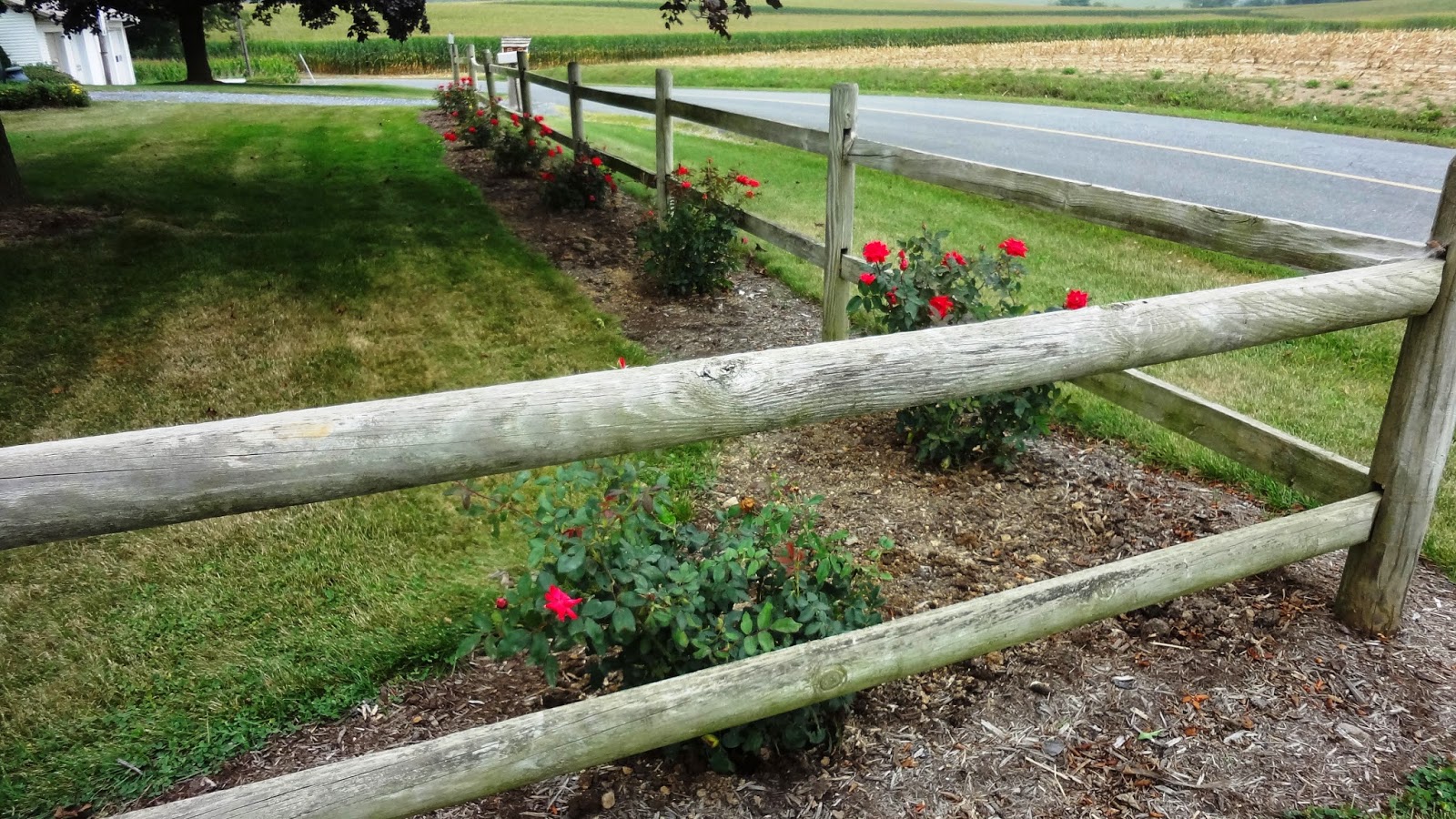
I have had red climber rose bushes at the rail fence across the front yard for many years. I've been threatening for at least five years to get rid of them but every June they would redeem themselves with a great show. And I would keep on spraying and pruning them, although I always came out of pruning looking like I was in a cat fight. They were nice about three weeks of the year and the rest of the time were unsightly with long canes reaching out all over the place that had to be tied down to the fence (another cat fight).
This year those climbers met their doom. Leroy yanked them out with a chain on the truck. I was not sorry to see them go. They tried to get the last word in the argument by jabbing me as I piled them up for burning. Now they are only a pile of ashes.


In their place we planted a row of double red Knockout Roses. They are a bush type that are easier to care for and bloom all summer.


They should grow to about four feet wide and high. I think it will be a great improvement and am looking forward to having roses all summer instead of just three weeks. 
I told Leroy he doesn't have to get me anything for birthday or Christmas this year because I'm getting roses now. He started counting off how many occasions eight rose bushes would cover--birthday, Christmas, Valentines, Mother's Day, anniversary . . .That's only five. Uh, Groundhog Day? Still two more. He'll think of something.

Sunday, August 31, 2014

Update

Here's another update on the progress of the church project. It's under roof now.
This is the new entrance on the back which faces the parking lot.


And this is the front facing the street.


There will also be a door on the end which does not show on these pictures. It's coming along but there's a long ways to go to the finish. The basement of the old building has been gutted down to the bare stone walls.


A new heating system is being installed now and there will be a new kitchen. The only thing left of the Sunday school rooms are the doors.


They were hoping to have the project finished by November but I'm not counting on it.

Sunday, August 24, 2014

Emmaus Tour

Emmaus was settled in the 1700s as a Moravian community. Other Moravian towns in Pennsylvania were Bethlehem, Nazareth, and Lititz. I'm familiar with Lititz and often thought I'd like to visit the other Moravian towns but it never happened. On Saturday we took advantage of an opportunity to join a bus tour going to Emmaus. This is our tour group at the last place we visited.


In addition to the town and it's founders, I learned some things about the Moravians. The Moravians trace their roots back to John Hus (1369-1415), a Catholic theologian who challenged the corruption of the Roman Catholic church and called for reforms. He was burned at the stake as a heretic in 1415 because of his insistence that Scripture is the final authority rather than the canon of law in the church.
Some of the Hussites wanted more radical reforms and formed a community in 1457 they called Unity of the Brethren. Separate from the Catholic church, and therefore illegal, the Unity of Brethren suffered persecution. Initially, they were similar to the Mennonites and Hutterites who appeared during the Reformation. Eventually there were three major branches of the Brethren within the Unity: Bohemian, Moravian, and Polish, named for the kingdoms where they were established. It is from the Moravian branch that the Moravian Church in America takes its name. 
The Unity of the Brethren was largely destroyed by war and persecution during the mid-1600s. The rebirth of the Moravian Church came in the 1720s in Germany under the leadership of Count Nicholas Ludwig von Zinzendorf. In 1732, the Moravians began sending out missionaries to the Caribbean, Labrador, Greenland, South Africa, and North America. They were more successful than any other denomination in evangelizing the North American native Indian tribes. 
Bethlehem was the center of Moravian activity in colonial America. They were known for their music, excellent schools for boys and girls (at a time when girls did not normally attend school), and missionary zeal. They were ecumenically minded and very persuasive in presenting their teaching. 
The Moravians were similar to the Mennonites is some beliefs such as nonresistance and noncomformity. But they are not Anabaptists as they practice infant baptism. Like the Hutterites, they lived a communal lifestyle. The community was owned and tightly ruled by the church. Detailed records were kept every day of the activities of the community which are a valuable resource today.
Clothing patterns were plain and simple. Until age 5 all children wore white dresses. At 5, they dressed like their parents with boys wearing shirts and knickers, and girls wearing dresses like their mothers. From age 5 to 12, girls wore red ribbons on their dresses and caps. From 13 to marriage they wore pink ribbons. Married women wore blue ribbons, and widows wore white ribbons. The dress included an overblouse, apron, and scarf. 

The oldest building at Emmaus is the Zuflucht Haus or Shelter House. It was built in 1734 near an Indian trail along the slopes of South Mountain. A small addition and second floor were added in 1741. It was seen as a shelter in case of Indian attacks but was never used for that purpose as the Indians were friendly and never caused any trouble.


The house has been restored and is on the National Register of Historic Places. The house was constructed in the typical three-room German floor plan. The front door opens into a long narrow Kuche (kitchen) with an opposing door at the back which provided good ventilation. The two windows on the right were the Stube (stove room) with the Kammer (bedroom) behind it. 
The Moravian culture touched the area after 1741 as missionaries began to branch out from Bethlehem. Community life centered around a small log church built in 1742 on land donated by Jacob Ehrenhardt. He and Sebastian Knauss eventually donated land to the Moravian Church for a new congregational village which was laid out in 1759 and after a time was named Emmaus.
The first log church building stood beside the God's Acre (cemetery). Although the church is gone, the cemetery contains memorial stones for nearly 400 individuals, including the founders of Emmaus and some Indian children who died while attending the Moravian school.

The Moravians laid their stones flat in the ground because they thought having a stone standing upright was a sign of pride.

The present Moravian Church in Emmaus was built in 1834.


In 1777, Heinrich Knauss built this log house for his father, Sebastian, who was one of the "fathers" of Emmaus. Sebastian died before the house was finished, so his son lived in it. Seven generations of the Knauss family were born in this house.


The day we were there they had a special event to recognize the 300th birthday of Sebastian Knauss. The town crier made some announcements and the current mayor (in top hat) read a proclamation. The mayor, Winfield Iobst, is a descendant of the first Burgess (mayor) of Emmaus.


In 1803 Jacob Ehrenhardt Jr. built this Federal style stone home for his family. As the son of one of the fathers of Emmaus, Jacob grew up in the closed Moravian village. Today the house is listed on the National Register and is cut off from Emmaus by the railroad track which runs right in front of the house.

The kitchen is attached to the back of the house, as was typical of the wealthy class. Their houses were to live in and everyday tasks such as cooking and laundry were not done in the main house.
Inside the kitchen.

I enjoyed the tour and learning a little about the Moravians. Someday I will go to Bethlehem and learn more.

Monday, August 18, 2014

Short Notice

I'm the kind of person who likes to work ahead make plans in advance. I like to know when things are going to happen and follow the plan. I get frustrated if the deadline is approaching and things are not ready to go. But I found out this weekend that sometimes I can go on short notice and things can happen without advance notice. 
My nephew, Jonathan, and his family who live in San Diego have been here on vacation for over a week. They have not been here for seven years and their time was pretty well scheduled full with his own family. There did not seem to be a time for the extended family to see him. We had been to San Diego a couple years ago and had seen them then. We thought we might have to be satisfied with that.
Then a window of time opened last evening. We had to drive over an hour to his parents home but that's a lot closer than San Diego. Amazingly, all four of our sons were also able to see him that day. Two of them had only a half hour notice. He was surprised when they showed up.
Some of Jonathan's sisters also were there and my sister had a full house for supper. I made some cole slaw to take along and other contributions appeared on the table. Jonathan and his wife are standing at the end of the table.


Everything worked out and everyone had a good time in spite of no prior planning. That said, I really don't see it as a life-changing event. I think I shall still prefer planning and preparing in advance.

Thursday, August 7, 2014

Progress Report

The work at the church is continuing and the addition is beginning to take shape. The walls of the new entrance are up. Framing the second floor is scheduled to begin next week.


The inside of the old building is also undergoing some remodeling. The work of tearing out the old is still being done. The old heating system with all the pipes and cast iron radiators is gone. Currently, the old tongue-and-groove board ceiling in the basement is being removed so the duct work can be installed for the new heating/cooling system. 


This building was constructed in 1876 by the Church of the Brethren. They remodeled the building several times before building a new facility down the street. In 1923 they dug under the building to provide a basement where they could cook the food for their Love Feast. This also provided Sunday school rooms and indoor bathrooms. It was modern and up-to-date for the time. Now, we are basically gutting the basement and upgrading to today's standards. 
So far we have been able to hold regular services but some adjustments had to be made due to the lack of Sunday school rooms. In October we will reach a point where the church will have to be closed for two weeks. By the time we are finished, we will have a new building inside an old shell.