Comments are welcome but please have the courtesy to sign your name. Unsigned comments will be deleted.

Friday, September 11, 2015

Truth Rises

Several years ago I came across a quote about Easter that I really like. It says:
"Easter says you can put Truth in a grave but it won't stay there. You can nail it to a cross, wrap it in winding sheets and shut it up in a tomb, but it will rise!"
My mother said the same thing once in words something like this: "You don't have to make a big fuss to defend yourself; wait it out and the truth will rise." I saw it happen this morning and the taste of victory is sweet.
I've been a member of FindAGrave for six years. On this website, people can enter burials and post pictures of gravestones. It's a great asset to those of us afflicted with genealogy disease. On this website I can find people in other states without going there. A gravestone is considered a primary source and seeing a photo of an out-of-state stone confirms information without requiring me to travel anywhere.
 However, the website is only as good as the people who post the information on it. Some people are more interested in quantity than quality. They will enter burials from a cemetery record in a library (secondary source) without checking for accuracy. Even worse, some will list burials from sources such as Ancestry.com family trees which are not regulated or to be trusted. And at the bottom of the ladder are people who simply guess and create memorials without anything to support them.
I ran into one such person this summer. He found a memorial page I had created several years ago with a photo of the stone as proof and wanted to claim it as his ancestor. When I detected that his information was not accurate and refused to let him have it, he got downright nasty. Most people I have met on FindAGrave are sensible and easy to work with, but not this one.
When I wouldn't surrender my lady to him, he went ahead and made memorials of his own for the lady and her husband with the information he wanted to believe. He changed her name to make it fit what he wanted it to be. I pointed out that these people could not be as his ancestors as they lived in another county and the county records showed the husband died a year before the one (with the same name) he was claiming. In addition, the lady was still living when her "husband" married his second wife. He claimed he had family records and can prove I'm wrong. I was not going to fight but neither was I going to accept his story when the facts showed otherwise. Anyone who could do the math would see his story didn't hold water. I just bided my time and waited for the truth to rise.
This morning I checked again to see the status of his fictitious person. It's gone! Either he finally did the math or enough people told him he's wrong. I suspect it was the later because he removed his email address from his profile. Whatever happened, the truth has risen!
 

Monday, September 7, 2015

Staunton Experience

My younger sister Carol has been a high school English teacher for thirty years. Last spring the school decided to give her "an experience" in honor of her service. She received an all-expense paid trip to Staunton, Virginia, to see a Shakespeare play at the American Shakespeare theatre and lodging at the Anne Hathaway Bed & Breakfast. (Anne Hathaway was Shakespeare's wife.) The B & B had three bedrooms so Carol decided to invite her two sisters and three friends to go along and fill up the place. (We extras each chipped in to pay our tickets, gas, etc.)
We left on Friday afternoon, September 4, and arrived at the B & B about 9pm. It was dark by then so we could not appreciate the beauty of the property until the next morning. The house was built in 2009 to resemble a drawing of Anne Hathaway's actual house in England, complete with a genuine thatched roof.
 
Although this place is right in town, it sets toward the back of the lot and a full English garden screens it from the road so it feels secluded.
 

The Great Room where we ate breakfast also had a comfortable lounging area in front of the fireplace. The owner of the place is from England and spoke with a strong British accent, which just added to the atmosphere.


The four younger members of our party slept in the two upstairs Romeo and Juliette rooms while my older sister and I slept in "William's Room" on the first floor.


After breakfast Saturday morning we went to the Frontier Cultural Museum a couple miles from the B&B. The museum features living history farms of the first pioneers who settled in the Shenandoah Valley. There is also a Native American home site and two farms from the 1800s.
We began our tour with a West African home. This one was included because of the large number of Africans who were brought to Virginia. The ground inside the family compound was intentionally kept bare as protection from deadly snakes. The buildings are kept wide and low to keep them cool. The one in the center is the man's "office" where he eats and does business. Just behind it is his sleeping house. About age 13 the boys begin sleeping in their father's sleeping house. Younger children sleep in their mothers' houses. The house on the right is the first wife's house and on the left is the second wife's house. Each one has their own outdoor kitchen.


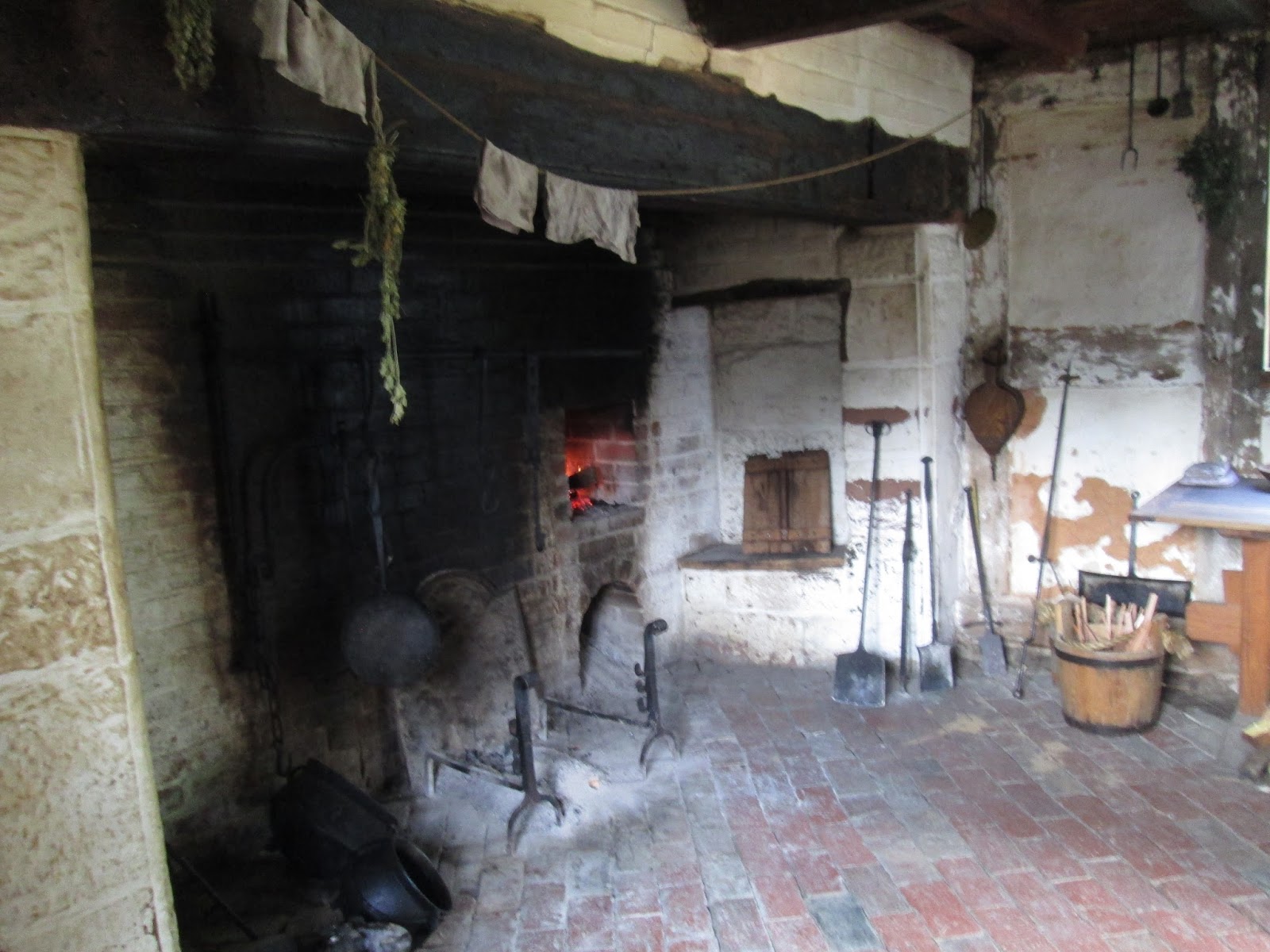
The English farm came from Worcestershire. It originally stood near the town of Hartlebury in England's West Midlands. This house belonged to a yeoman, a class of independent landowning farmers who sent many sons and daughters to Virginia in the mid-to-late 17th century. This family's main source of income was wool. The pieces of this house were numbered as it was dismantled in 1992. It was shipped to America and reassembled in the museum in 1993.


The Scotch-Irish (Ulster) farm formerly stood on the townland of Claraghmore in East Longfield Parish, near the town of Drumquin in County Tyrone, Northern Ireland. This was the first of the structures acquired by the museum in late 1984 to early 1985. Staff members numbered and shipped 174 tons of stone to Virginia to reconstruct this Irish farm.
The family lived in one room on the left side of the center door. The room on the right side of the door is where the father wove into cloth the wool and flax the family produced. The parents had a bed and the father had a chair but children slept on the floor and everyone sat on the floor to eat. At this point in history their main food was oats. They raised potatoes but considered them horse food.


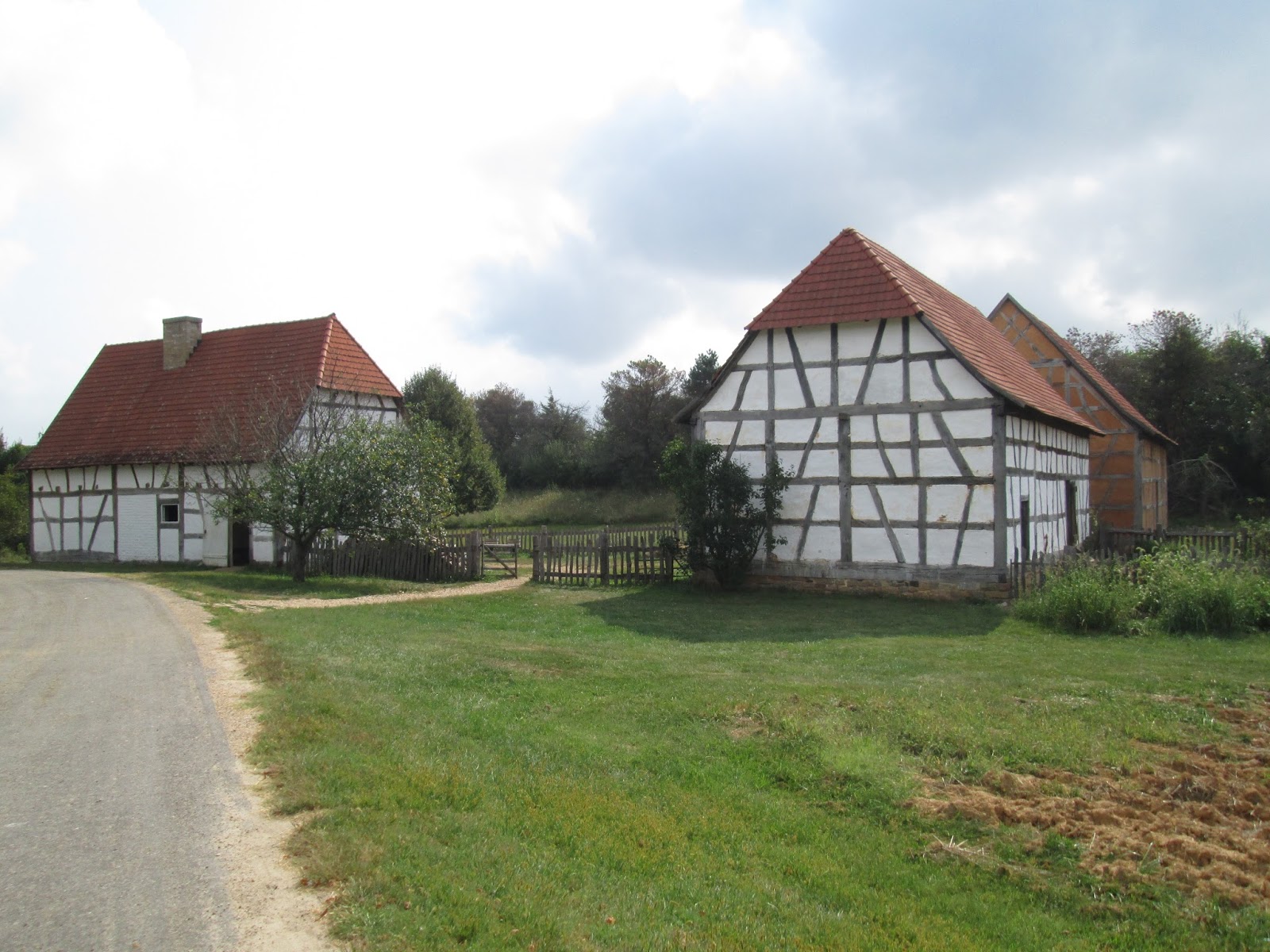
The German farm, acquired in 1991, had the most familiar look to me. The first mass exodus of Germans from the Palatinate occurred in 1709 and continued through the 1750s. Pennsylvania became the focal point for German settlement in America. Most of the German-speaking people who settled in Virginia went there after living Pennsylvania for a period of time.
From the late-17th century to the late-20th century, this German farm stood in the small village of Hordt in the Rhineland-Palatinate. German farmers' homes and barns were in the villages but their fields were outside the village. The ownership of this house has been traced back to Johann Jacob Wolf and his wife, Maria Appollonia Buchman, who were married in 1784. The date "1688" is carved into the northeast corner post of the house and may indicate the date of construction.


The path then took us "across the water" to America where we visited a Native American home. The type of house the natives built depended on location and tribe. This one is not portraying any particular tribe but is just intended to give a general idea of a native home.


We visited a replica of a 1740 pioneer home. One thing I noticed was that although the style of construction varied, the majority of the houses were built of some combination of wood and earth.


The next American house is called the 1820 house, although the original (left) part was built in the 1770s by Johannes Bauman of Berks County, Pennsylvania. His grandson added the right section in 1820. Bauman's house was moved to the museum from Timberville, Virginia. Notice how much "progress" has been made since 1740.


Across the road from the 1820 house is the 1860 house, which is again more elaborate. It includes a spring house, large barn, and other buildings. This farm was moved here from Botetourt County, Virginia. It originally stood southwest of the town of Eagle Rock. This farm was built by the Bargers, a family of German descent. The builder's grandfather had settled in Rockbridge County in the 1790s. His son moved to Botetourt. In 1832, John Barger bought 187 acres along Little Patterson's Creek and began work on his house in 1835. As the family grew, the house was expanded with an addition on the right side.


This concluded our tour of the museum and we returned to the B & B to freshen up for the next event. After a bit of wandering we found our way to the Blackfriars Playhouse to see William Shakespeare's Julius Caesar. The American Shakespeare Theatre is a replica of the Globe Theatre in England where Shakespeare's plays were originally performed. Unfortunately, no photography was allowed so I don't have any pictures from there.
Julius Caesar is one of the Shakespeare plays Carol teaches at school. She said she wouldn't be able to recite it but as she watched it being performed she knew what the actors would say next. Afterward, she told us how she teaches it. Some of the points she makes from it is that it's never right to do a wrong and the end does not justify the means. I enjoyed watching it even though I wasn't able to brush all the hay seeds out of my hair.
We ended Saturday with a picnic in a park and then went back to the B & B to relax, play games, etc.
Sunday morning we checked out of the B & B and went to services at Staunton Mennonite Church. It's a small but friendly congregation.


After church we headed up to Bridgewater and had lunch with some of Carol's friends, Mike and Sarah Showalter. About 3pm we hit the road north. We survived the trip in spite of the fact that it was in the 90s all weekend and the AC in the van wasn't working. Carol discovered it had given up the ghost about a half hour before we left on Friday. We looked forward to this trip all summer and made a lot of memories that will last as long as we do. I was honored to be included in this "experience."

Wednesday, August 26, 2015

School Days

I've been enjoying seeing the first-day-of-school pictures the Mamas are proudly posting on Facebook this week.
I couldn't help comparing these pictures with the days when my own children started school. If we took pictures at all, it was with film and weeks later before we saw the pictures. And then the photo may have been a dud that did not properly preserve the moment.
Reading the comments mothers are making with their photos tells me that even though technology has changed, mothering has not. There is pride and excitement at seeing the first one march off to kindergarten or first grade, and also some sadness and trepidation. The little one that has been under our care 24/7 is now going out into the big scary world where others will have an influence on him or her.
By the time the last one begins the march to the first day of school, mothers have gotten used to sending children to school and the tone of the comments changes. There is still excitement but with the flavor of relief. At last! I have a quiet house all day to get things done without someone underfoot. I can identify with that feeling too. How long a mother has preschoolers varies with the number and age spread of the children. Since our six were spread over fifteen years, I had preschoolers in the house for twenty years. I wasn't sure I knew how to function without a preschooler around when the last one started kindergarten. It took me about two days to get used to and decide I liked it!
For so many years, my daily and annual schedule revolved around school---buying new clothes and school supplies in August, packing lunches, driving to and from school, helping with homework, going to school functions, paying tuition. After the last one graduated from high school we had a break for a few years and then he started college. Our involvement in school days began in 1974 when the first one went to first grade and ended in 2010 when the youngest graduated from college.
This is my moment of triumph at crossing the finish line. All done but the shouting!
 
School was a fact of life for many years. I didn't hate it, but I certainly am counting my blessings that I don't have to deal with school anymore. Been there done that.

Tuesday, August 25, 2015

True Evangelical Faith

If you are a Mennonite or another branch of Anabaptist, you are probably familiar with the words of Menno Simons in which he describes the nature of true evangelical faith. A beautiful song has been written using some of the words and titled True Evangelical Faith. The words in the song are highlighted below.

For true evangelical faith is of such a nature that it cannot lie dormant,
but manifests itself in all righteousness and works of love;
It dies unto all flesh and blood;
it destroys all forbidden lusts and desires;
it seeks and serves and fears God;
it clothes the naked;
it feeds the hungry;
it comforts the sorrowful;
it shelters the destitute;
it aids and consoles the sad;
it returns good for evil;
it serves those who harm it;
it prays for those that persecute it;
teaches, admonishes, and reproves with the Word of the Lord;
it seeks that which is lost;
it binds up that which is wounded;
it heals that which is diseased and it saves that which is sound.
It becomes all things to all men.
Menno Simons, 1539
 
In statements flanking either side of the highlighted text above, Menno emphasized how true faith will press on to righteousness, love and obedience. True faith results in love for God which leads to obedience to the commandments of God.
I'm not saying this song is wrong, but the truncated quote emphasizes a social gospel and leaves out the aspects of evangelism, righteousness, and suffering which were very much part of the original Anabaptist vision.
As we reflect on Menno’s full version, let us awaken the other areas that embody true faith. Self-denial and obedience are qualities that the majority of American Mennonites are not familiar with. Prosperity has made us soft and we know nothing of the persecution that was part of everyday life for our Anabaptist forefathers. While true evangelical faith does meet the physical needs of the suffering, it is much more than that and we dare not omit the more weighty matters such as righteous living, self-denial and obedience.


Friday, August 21, 2015

Change of Seasons

The summer is winding down and subtle signs of fall are approaching. Back-to-school sales are popular right now. Leroy cut down the corn this week and the garden is empty except for tomatoes and potatoes. It seems just yesterday that we planted and we're at the end of harvest already. Yesterday  I heard some Canadian geese circling overhead. Another sound of approaching fall.
I take a break from housecleaning over summer but the seasons begin to overlap when the cycle begins again at the end of August with scrubbing the front porch and patio in back of the house. I like to do them while it's still warm enough to slop with the hose. I always wind up getting wet but soon dry off again on a warm day.
I did the porch yesterday with the help of a 3-year-old grandson who was spending the day with me. He loved it! Leroy put a different kind of nozzle on the hose and I wasn't going to show him how it worked because I knew what would happen. Well, he figured it out himself and the results were as expected. We both came in soaked, but soon dried off again.
This has been a very busy year, beginning with our trip to Texas at the end of March. May was extremely full and there was one thing after another all through June, July, and August. The corn, tomatoes, peaches, and apples are all canned now and the dust is beginning to settle. But now the summer is almost over. I'm just thankful we are in good health and able to do all these things.
I shall not lack for things to do in the fall. I always have a to-do list and it is always supplemented with things that pop up as we go along.

Friday, August 14, 2015

Kitchen Adventures

Well, that was interesting! I don't recall ever bandaging myself on a spot I couldn't see. It sure would have helped to have a ball joint in my ankle.
What happened? I pushed a chair to the sink to get something that was above my reach, which incidentally isn't very high. When I picked it up slightly to position it, I didn't notice the floor protector had fallen out of the chair leg (nail point up) and stepped squarely on it. Gusher!
I put my foot on a Kleenex and slid it to the bathroom where I made another mess trying to stop the bleeding. A Band-Aid didn't work. It was soaked before I got it in place. So I got out the bag of sterile pads and gauze, but I still wasn't sure exactly where the puncture was. There was no one around to help me so I put a mirror under my foot to locate the source of the gusher. Ah! There it is, at the bottom of the fourth toe.
I'm not very proficient at bandaging and self-bandaging by looking in a mirror is awkward , but I got it done and stanched the flow. Now I'm hobbling around trying to get food ready for supper tonight. The company is just going to have to overlook the pink slipper I'm wearing to keep the bandage clean.
 

Thursday, August 6, 2015

Drought in Haiti

My niece has been operating a clinic for ten years at La Source in northern Haiti. Here is a portion from her last email:
 
"We've been having a drought--the worst one in the 10 years I've lived here.  People usually plant beans, corn and peanuts in April or May.  This year there were a few good rains but they did not continue. People planted twice, but each time the plants withered and died before they got to be a foot tall--there wasn't even anything worth giving their goats, donkeys and sheep of the remaining plants.  This is normally a hungry season, supplies from the harvest in January are dwindling and crops planted in April or May are just beginning to be harvested.  Children, who often receive a free lunch at school, are all at home depending on their parents for food.  This year is even worse, not only because there isn't food around but also because there is no hope of food in the foreseeable future. . .
In August hopefully the rains will come more regularly again allowing people to plant millet, beans and a few more peanuts (although some people have already sold their seed stock in order to buy food), but even then the harvest wouldn't be ready until January. 
We are getting lots of requests to help people pay off food that they've bought on credit from local merchants. It is challening to know how to handle them because in many ways it feels like a bottomless pit.  We can help them pay for food they bought two weeks ago, but that's been eaten long ago and they still need food to eat today and tomorrow and if they couldn't pay for that food how are they going to pay for the next batch?  People are willing to work, but it is impossible for us to employ everyone. . . .
The next few months will be difficult ones as families scrounge for money to send their children back to school, money to buy them new uniforms, shoes and books.  The staff will be under considerable pressure to help pay schooling for people and it is impossible to help everyone.  I'm sure they'd appreciate your prayers for wisdom to prioritize and how to best help."
 
As I took my morning walk yesterday and saw the tall corn and lush growth on every side, I remembered our dry spell in May. The corn I planted in the garden did not come up and I wondered what kind of summer we were going to have. But then the rains came, the corn came up, and regular rains produced an abundant crop. I tried to imagine how it would be if the rains had never come and wished I could send some of our excess to the hungry people in Haiti.
That very day, we got a letter from Christian Aid Ministries (CAM) which also described the famine in Haiti caused by the drought. They are sending corn and beans to the La Source area. I can't send my excess to Haiti but I can send money to CAM to help feed the hungry in Haiti.
If you would like to help, send your donation to Christian Aid Ministries, P.O. Box 360, Berlin, Ohio 44610. Mark it for Drought in Haiti.

"Inasmuch as you have done it unto one of the least, you have done it unto me."