Comments are welcome but please have the courtesy to sign your name. Unsigned comments will be deleted.

Wednesday, August 28, 2019

Change of Dreams

Have you accomplished everything you dreamed of doing? I haven't. The two biggest dreams of my life were to be a stay-at-home wife and mother and to be a writer. Those dreams became reality but there were other dreams that never happened and died as time passed. At one point I thought that when my children are all in school I will get a part time job in a bakery. When my youngest child went to school, I knew getting a part time job was a foolish idea. I had too much work at home to think of working anywhere else. The writing I was doing was already a part time job at home.
My daughter dreamed of being a nurse and enrolled in college to begin training. Then she met her future husband, changed course, and became a stay-at-home mother. My son dreamed of being a flight nurse on a helicopter. He went to college and became an RN but changed his mind after working in the ER for five years and is now in ICU which is a better fit for him. Another son once dreamed of being a doctor but instead is now in business management. Another dreamed of being a long haul truck driver. He did it but learned it wasn't all he dreamed, shifted gears and went into other things. Another dreamed of having a large family and got it, not the way he expected, but by adoption.
A change of dreams is not a sign of failure but of growth. Circumstances and interests change with the passing of time and lead us to new things. Sometimes we even surprise ourselves by doing things we never dreamed of doing. In time, we see that some dreams were unrealistic and not worth pursuing. Life is a journey and a change of dreams opens the door to new adventures. 

Tuesday, August 13, 2019

Sneak Preview

I'm happy to announce that the wait for my latest book is almost over. As usual, it took about 18 months from the time I submitted the manuscript to the publisher to produce a finished book. This one should show up in bookstores sometime in September. 
My brother Merle was always a good story teller. He wove many stories of his experiences during forty years in missions into his sermons. People kept telling him he should put some of those stories in a book but he didn't think he had the time to do that. 
I told him to tell me the stories and I will write them. We began during the winter of 2017-18 and finished that spring. Because he is such a good story teller, it was one of the easiest books I've ever written. Of course, it is always easier to get information from a living person than to dig it out of old books and documents.
Merle left Pennsylvania in 1978 with a one-year commitment to serve at Northern Youth Programs as office manager. He never came back and is still in northwestern Ontario, although he now lives at Sioux Lookout. He took his family to Haiti in 1989 and spent that year working with a Haitian Mennonite church.
Merle is administrator of Open Hands which was launched in 2009. It is a ministry that helps people in poor countries learn to save and manage their money. This takes him around the world. The book contains stories from Merle's experiences in Canada, Haiti, India, Africa, Nepal, Thailand, and more.
Most of my books have been published by Christian Light in Virginia but after some deliberation I decided to give this one to TGS, an arm of Christian Aid Ministries, because some of the stories involve their organization.
This is the cover of the book Led By His Hand. Watch for it in your Christian bookstore or order from TGS,  https://tgsinternational.com/.


Monday, August 5, 2019

Rerun

I don't have a TV but I've heard that summer is the season when they do reruns. So today I'm going to do a rerun.
Yesterday in Sunday school the lesson was on faith and believing God can do the impossible. At the end of the class we were asked to share personal experiences of God at work. The teacher said it didn't have to be something real big, God cares about the details of our lives too. Someone shared an experience, but we were running out of time and I didn't say anything. This morning as I was walking I thought of a time I could have shared and here is my rerun from a few years ago.

The Kleenex Sign

I've known for over a year that I was heading for a point when I would have to make a difficult decision. It was easy to ignore as long as it was in the dim future. But now it is looming larger on the horizon and I will have to deal with it in the next month or two. How can I know what is the best choice?
Gideon put out a fleece and asked God for a sign. Zacharias found himself suddenly unable to speak when he asked for a sign. I'm fresh out of sheepskins and am not interested in being speechless. So I packed up my questions and went for a long walk. Somehow walking seems to help straighten out the kinks in my thinking.
I was not far down the road when I realized I could use a Kleenex. All my pockets were empty. I kept on going, sniffing and trying to make the best of a bad situation. And then! Believe it or not, there was a clean white Kleenex caught on the weeds beside the road. I grabbed it and used it, and a few steps further on I found another one.
The Kleenex did not give me the answer to the choice I must make but it did give me some reassurance that I need not rely on my own resources to make the decision. God provided a fresh Kleenex along the way when I needed it and one to spare. Surely He will show me which way to take when I stand at the fork of the road and the choice must be made. Whether it's a big decision or something as small as a Kleenex, what a comfort and blessing to know God is with me and will not let me down!

God put a ram in the thickets for Abraham and a Kleenex in the weeds for me. He gives us exactly what we need when we need it. And I am happy to report that God did help me make the right decision. 

Wednesday, July 24, 2019

Konigmacher House

I grew up near the Ephrata Cloister in Lancaster County. I remember when the Cloister Shopping Center was built across the road from the Ephrata Community Hospital where my younger siblings were born. It is familiar territory, but this week I saw it with different eyes as I dug through old deeds and maps. 
Much of the land where the shopping center and hospital stand today was farmed by several related Konigmacher families who descended from immigrant Adam Konigmacher (1738-1793). The Konigmachers were householder members of the Ephrata Cloister, meaning they lived in the surrounding area and worshiped at the Cloister but did not live on the grounds or take a vow of celibacy. Many of the Konigmachers are buried in the cemetery of the Ephrata Cloister.

Below--view of the Cloister buildings from the cemetery entrance.

Two of the Konigmacher houses are still standing. One is on the corner of Route 272 and Martin Avenue, in front of the hospital. It was built by Benjamin Konigmacher about 1910 and was the birthplace of Joseph Konigmacher, founder of the Mountain Springs Hotel on the hill above the town of Ephrata. The other Konigmacher house is directly across 272 in the rear of the shopping center. Today it is a Kingsway Realty office.


This house was built in 1777 by Michael Miller, a member of the Cloister. It was the home of Adam and Eliza (Royer) Konigmacher. Adam (1821-1889) was the son of William (1797-1881) who was the son of Jacob (1771-1839), son of immigrant Adam (1738-1793). 
Adam and Eliza Konigmacher had three children, Jacob Konigmacher (1850-1912), Susan (1852-1917) wife of John P. Hess, and Elizabeth "Lizzie" (1853-1931), wife of (1) Henry Musser (2) Philip Nagel. Susan moved to Iowa and Lizzie to Illinois. Jacob got the family farm from his father and lived there until his death in 1912. He had one son, William Konigmacher, who married Anna Steinmetz. 
Jacob was a prominent person in the community. He was one of the organizers of the Farmers' National Bank in Ephrata where he was a director and vice-president. He was a trustee in the Ephrata Monument Association, serving as secretary and treasurer. He was a member of the Lutheran Church and the Pennsylvania German Society.
After Jacob's death, the farm was sold to Martin L. Zimmerman. This is where our connection to the place comes in. By 1944, Martin was getting old and needed help. Leroy's parents had been married for a little over a year and lived on another farm. They moved into the tenant house on Martin Zimmerman's farm and Pop was the hired man. Leroy was three months old when they moved to this place and they only lived there for one year so he does not remember it.
From the memories of his parents, we know the tenant house was to the left of Martin's house. The place where the shopping center is now was a meadow where cows grazed. When I look at the place now and see what was done in the name of "progress" it seems a shame that a once lush pasture is covered with asphalt, stores, and a McDonalds. Noisy traffic rushes by on a busy road that was once a quiet, peaceful farm.
During the year Leroy and his parents lived in the tenant house, the bridge was built over Route 322. The 272 (then called 222) had been built but the bridge had not because the materials were hard to obtain during the war. The road could not be used until the bridge was built to connect the two parts of 272. When the bridge was being built in 1944, Pop went out to watch and the man operating the crane allowed him to come in the cab with him.
After a year on the Zimmerman farm, Leroy's parents moved to another farm south of New Holland. That is where Leroy's earliest memories were made. They lived there until he was nine and then moved to Berks County where they lived the rest of their lives.


Tuesday, July 9, 2019

Sign of Jonah

The Pharisees and Saducees asked Jesus to give them a sign from heaven to verify His words. He told them, "A wicked and adulterous generation seeketh after a sign; and there shall no sign be given unto it, but the sign of the prophet Jonas. (Matthew 12:39). 
What was the sign of Jonah? The next verse gives us a hint. "For as Jonas was three days and three nights in the whale's belly; so shall the Son of man be three days and three nights in the heart of the earth." I always thought the significance of that statement was the "three days and three nights." But that's missing the point.
What happened after the three days and nights? Jonah came out of the fish after three days and nights. He essentially came back from the dead for who ever survived in a whale's belly that long? Jesus was actually saying He would rise again after three days. He was prophesying His resurrection but they didn't get it. And neither did I for a long time. I was hung up on the three days and missed the deeper meaning. Now let's take it to the next level.
The resurrection was the central message of the early church. Peter preached the resurrection on the day of Pentecost and 3000 souls were converted. The apostles preached the resurrection everywhere they went, even to the highly educated on Mars Hill at Athens. 
When persecuted by the Romans in the first centuries after Christ, Christians used the fish symbol to mark meeting places and tombs, or to distinguish friends from foes. According to one ancient story, when a Christian met a stranger in the road, the Christian sometimes drew one arc of the simple fish outline in the dirt. If the stranger drew the other arc, both believers knew they were in good company. The fish is still used as a Christian symbol.
What does a fish have to do with Christianity? Was it because Peter was a fisherman? Because Jesus said Christians should be fishers of men? Because fish swim in water and Christians are baptized with water? All those are weak theories. 
To early Christians, the fish was a symbol of  the central doctrine of the Christian faith, the resurrection. It is the sign of Jonah. The cross is the symbol of Jesus death; the fish is the symbol of His resurrection. Think about that the next time you see a fish on a bumper sticker.


Monday, July 8, 2019

Missing Persons

One of the things I love to do is track down a family that no one seems to know what happened to them. I just scored another victory with a Stauffer family. I had five generations of the Stauffer family from Mathias to David but that's where his line stopped. Was he never married? No one seemed to know.
David Stauffer was born in 1833 to Henry and Anna (Shirk) Martin. David died in 1876 and was buried in the Weaverland Mennonite Cemetery. That's all I knew about him. I started digging and found his estate papers in Berks County. He moved to the city of Reading about 1872. His will said he had a wife "Mattie" (nickname for Martha) and a son Theodore D. Stauffer. More searching turned up Martha (d. 1895) and Theodore, both buried at Churchtown. Two missing persons found!
Theodore was born in 1864 and died in Reading in 1913. I found his obituary in the Reading Eagle. It said he had one sister, Mrs. Charles Heist. That was a speed bump but I soon found his estate papers which showed that Mrs. Charles Heist was actually his daughter, not his sister. Her name was Helen M. Heist and she was his only child.
Helen was married to Charles Heist in Chicago in 1912 when she was 23 (if she was honest about her age on her marriage license). I don't know what the story is behind being married in Chicago because they were both born in Pennsylvania. They had one son, Charles Jr. Helen and Charles wound up in Buffalo, New York, where they died and were buried. Charles died in 1954 and Helen in 1964. 
Charles Heist Jr. was born in 1916 in Chicago and married Clydis McLendon.  In 1954, he founded a painting and sandblasting company he named after himself, C. H. Heist Company. He had a son, C. H. Heist III who took over the company when Charles II died in 1983 in Florida. Clydis died in 2005.
Charles H. Heist III was born in 1950 and the C. H. Heist company grew to a large corporation under his leadership. He had a son Charles H. Heist IV born in 1982 who is living in Florida today.
That completes the descendants of David Stauffer. It's the kind of puzzle I like to put together. It took some searching but all the pieces were found on the Internet. Genealogy research has become much easier with so many resources available without leaving home. I would have spent a day going to the courthouse to find the records I could see with a few clicks of a mouse. 


Wednesday, June 26, 2019

Longwood Gardens

We went to Longwood Gardens more than fifty years ago when we were dating. I hoped to go see it again in April when the spring bulbs were blooming, but it was not to be. Leroy's hip and my left leg were making walking difficult for both of us. We postponed it until we recover and decided to go either June 25 or 29, depending on the weather. Then we learned Gerald and Kelly were planning to go on June 25 and take her parents as their 2018 Christmas gift. They invited us to join them and we took them up on it. 
The weather cooperated and it was a beautiful day. I still wasn't up to walking that much so Gerald got one of the scooters the Gardens provides for people who are unable to walk through the huge gardens. When we were dating I never imagined the next time I'd come I'd use a scooter. Even if you would have been able to show me a picture of us now, I not have believed it. But fifty years does not pass by without change and it certainly is obvious. 
Longwood Gardens is just as beautiful as it was 50 years ago, and probably larger. I don't remember enough of what we saw so long ago to compare it to today. Besides, we were dating and more interested in each other than the gardens. It was just an excuse to walk around holding hands. 😊
Longwood Gardens is a botanical garden of over 1,077 acres of gardens, woodlands, and meadows in Kennet Square, Pennsylvania. It is open to visitors year-round to enjoy exotic plants and horticulture both indoors and outdoors. The Conservatory contains 4,600 different types of plants and trees, as well as fountains.
Pierre S. du Pont (1870-1954) began developing the outdoor gardens after he purchased the property in 1906. He added the 600-foot long Flower Garden Walk in 1907. Longwood's conservatory, opened in 1921, is one of the world's great greenhouse structures. The Main Fountain Garden debuted to the public in 1931 and was the last major project in the Gardens during Pierre's life.
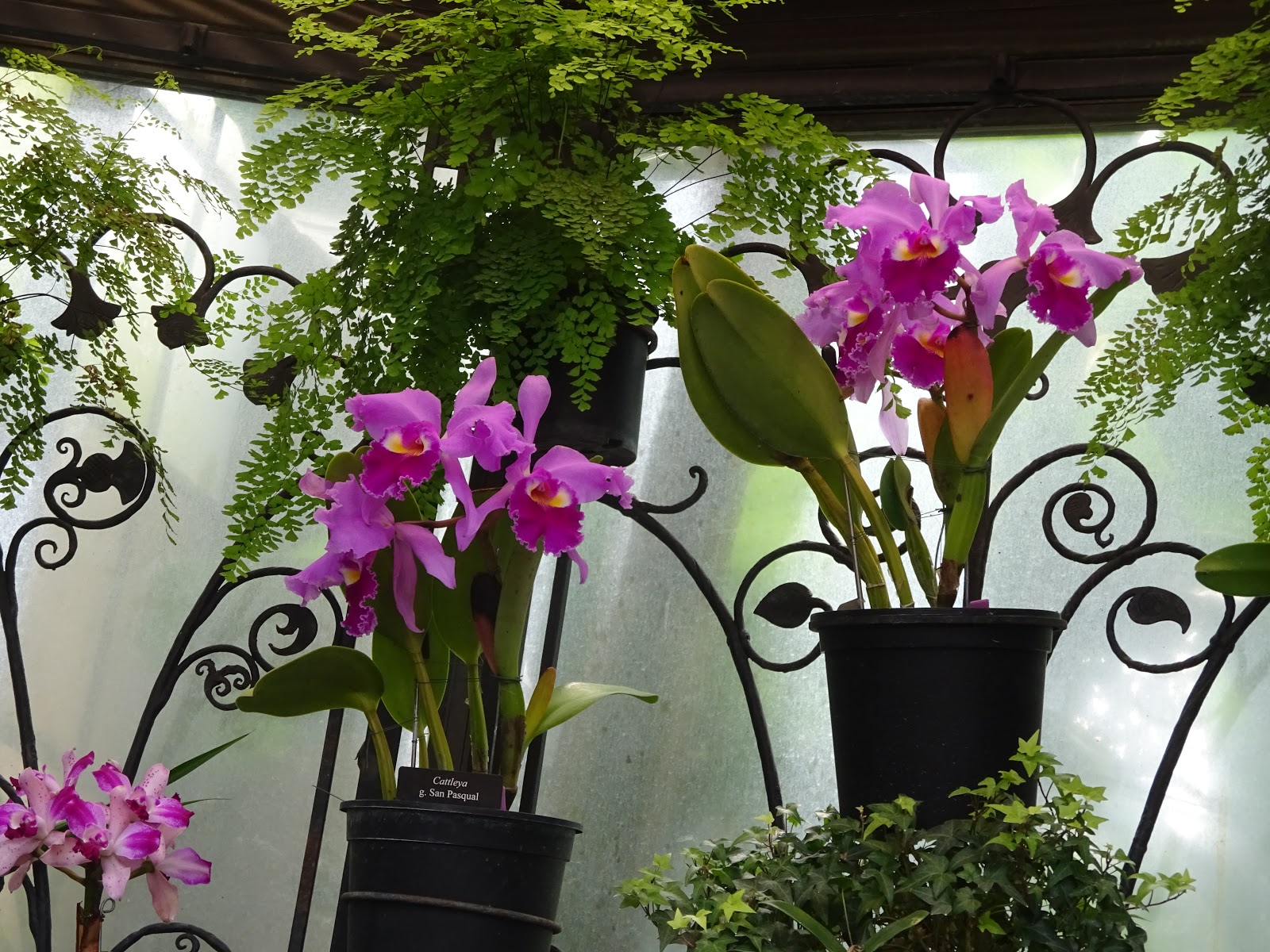
"A picture is worth a thousand words," so walk with me through the Gardens. The first eight are in the Conservatory. 


This Japanese Bonsai tree is 125 years old.


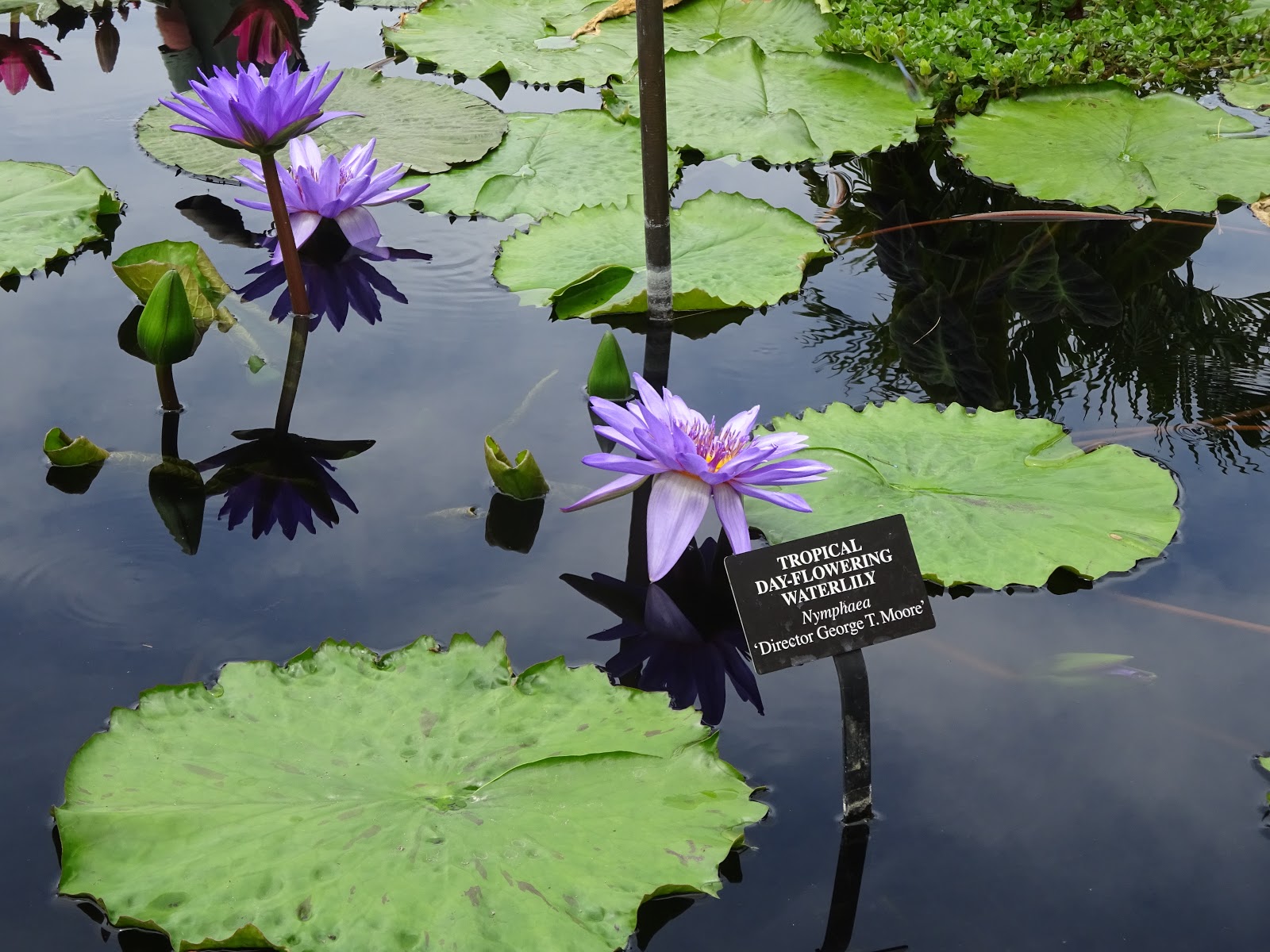
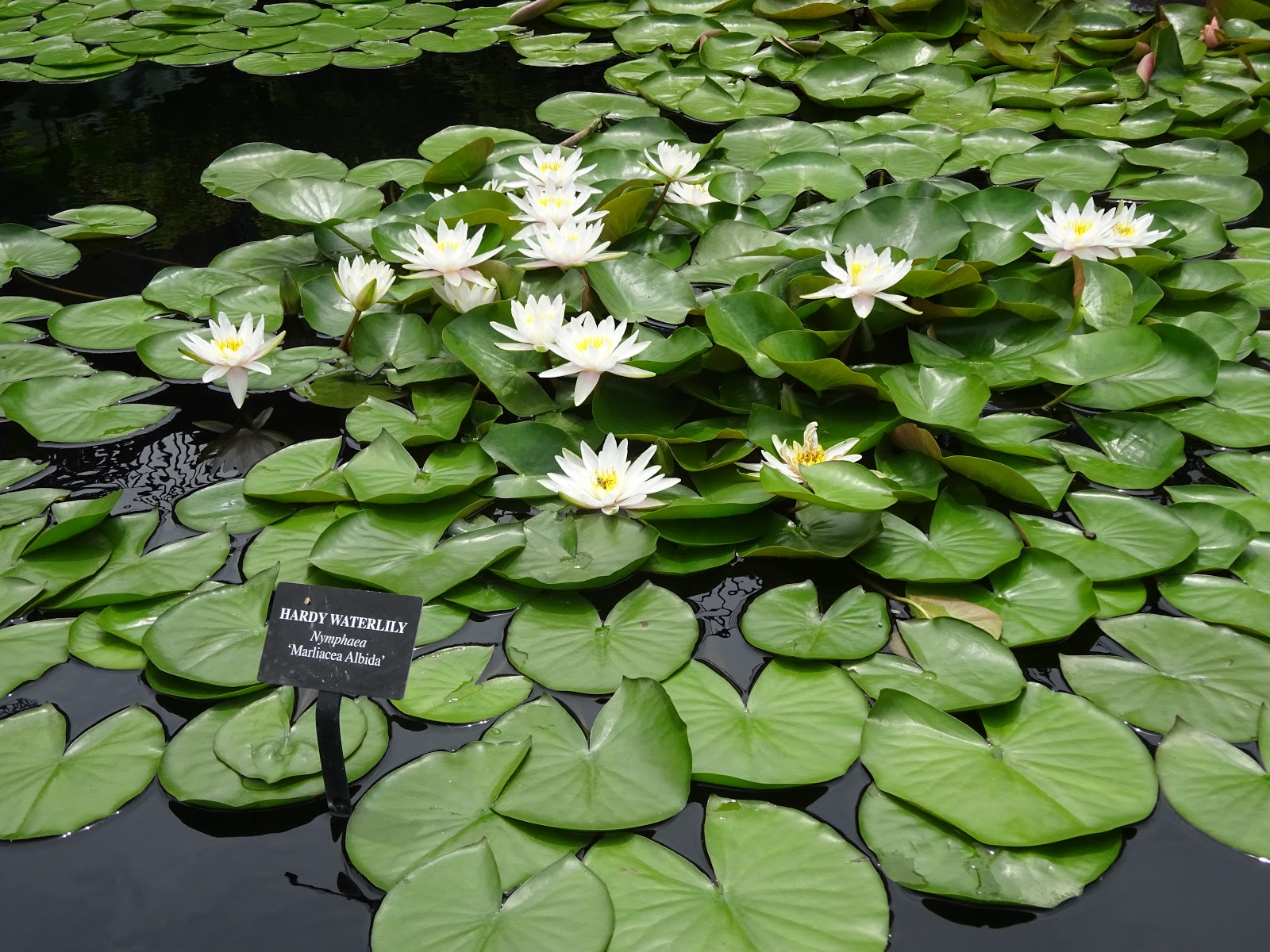
The next five are the Waterlily Gardens. The round things among the lily pads are a living plant called a Water Platter. 


 The main fountain (above) and Italian Water Garden (below). Elaborate displays are done several times each day at the main fountain. The water is synchronized with classical music.

The next pictures are of flowers on the grounds. 
Common Allamanda from South America (below).


The roses were past their prime but some were still beautiful.

I don't know what these two are.