Comments are welcome but please have the courtesy to sign your name. Unsigned comments will be deleted.

Wednesday, September 28, 2016

Grandma Privileges

Generations of school children from Berks and surrounding counties have gone on field trips to see Roadside America at Shartlesville, Pennsylvania. It is a miniature village and railway created by Laurence Gieringer that covers 8,000 square feet. The village was first displayed to the public in 1935 and placed in the current building in 1953. The current display is beautifully maintained; exactly the way Mr. Gieringer left it when he passed away in 1963. It is operated today by his granddaughter and her family.
Unfortunately, the building has aged and is in need of a new roof. The business generates enough income to support itself but not enough to pay for a new roof. If the funds are not found, it may be forced to close.
All of our children went to Roadside America on school trips and I thought Grayson should not miss the experience. So I took him to see it today. He was very impressed! I told him we're going to see some trains and when we walked in he said, "Wow!" 


He was fascinated with the trains until he discovered the buttons that make the display interactive. Then he went from button to button, pushing them to see what would happen. Some made trains and trolleys run, turned windmills, rang bells, moved wheels, ran elevators, and all kinds of interesting things.


We circled the display three times before the night show began. Then we sat on benches at the back of the room while the "sun" went down and all the lights in the little buildings turned on. After a period of darkness and stars (while an airplane circled the center), morning came and we returned to daylight. Grayson loved the night show. We circled the display for the fourth time and then he decided he was ready to go. We were there at least an hour or more.
It was lunch time when we left and I decided we should top off our field trip with ice cream. So we stopped at a dairy store and got cones. When we got out of the car Grayson said, "Mommy says I must eat my hot food first." But grandmas operate by different rules so I told him we're going to do it backwards today and have our ice cream first. Grandma Privileges! 
Being a chocoholic, Grayson didn't consider anything other than chocolate and I had raspberry. But you can guess what happened. By the time he had eaten his cone he didn't need hot food when we got home. 


I enjoyed watching him as much as he enjoyed pushing all the buttons. I can remember things that happened when I was four. Did we make a memory today that will stay with him all his life? I hope so. It's moments, not things that usually make the longest-lasting memories.

Friday, September 23, 2016

Hitlerian Thinking

This editorial by Richard Coehn in yesterday's Reading Eagle makes some good points.

The Economist magazine is rarely wrong, but it was recently in strongly suggesting that the casual disregard for truth that is the very soul of Donald Trump's campaign is something new under the sun. The technology--tweets and such--certainly is, but his cascade of immense lies is not. I'd like to familiarize The Economist with Adolf Hitler.
I realize Hitler's name has a distractive quality, and I cite it with reluctance. Hitler, however, was not a fictional creation but a real man who was legally chosen to be German's chancellor, and while Trump is neither an anti-Semite nor does he have designs on neighboring countries, he is Hitlerian in his thinking. He thinks the truth is what he says it is.
Soon after becoming chancellor, Hitler announced that the Jews had declared war on Germany. It was a preposterous statement since Jews were less than 1 percent of Germany's population and lacked the ability to make war on anything. In fact, in sheer preposterousness, it compares to Trump's insistence that President Barack Obama was not born in America--a position he held even after Obama released his birth certificate.
At the time, people tried to make sense of Hitler's statements by saying he was seeking a scapegoat and had settled on the Jews. I know of no instance where Hitler confided that his statements about Jews were, as we might now say, over the top. He remained consistently deranged on the topic. He was not lying. For him, it was the truth.
Just as Hitler's remarks about Jews were deeply rooted in German anti-Semitism, so was Trump's birtherism rooted in American racism--with some anti-Muslim sentiment thrown in. Trump's adamant insistence on it raised issues not, as some have so delicately put it, about his demeanor, but instead about his rationality. It made a joke out of the entire furor over revealing his medical records. I'm sure that Trump is fine physically. Mentally, it's a different story.
In a purloined email, Colin Powell called Trump's birther fixation "racist." But the former secretary of state has never done so publicly and his hesitation about Hillary Clinton is no excuse for being AWOL in this fight. Like some other GOP grandees, he has retreated to a neutral corner. They all have their qualms with Clinton, but not a single one of them can possibly believe America and its values wont' survive her presidency. A Trump presidency is a different matter.
It's a mistake to make the unreasonable compatible with the reasonable--to think, say, that Trump cannot be serious about this birther stuff or building a wall. That was the authentic Trump, a man totally unburdened by concern for anyone else.
There is no lie that cannot be believed. Even after Germany had murdered most of Europe's Jews, allied investigators at the end of World War II found that many Germans believed that their country's defeat only confirmed the power of world Jewry. Germany was not some weird place. At the advent of the Hitler era, it was a democracy, an advanced nation. It had unique history and cannot easily be likened to the contemporary U.S. But it was not all that different, either. In 1933, it chose a sociopathic liar as its leader. If the polls are to be believed, we may do the same.

"When they knew God, they glorified him not as God, neither were thankful; but became vain in their imaginations, and their foolish heart was darkened. Professing themselves to be wise, they became fools, wherefore God also gave them up to uncleanness through the lusts of their own hearts" (Romans 1:21-24).


Thursday, September 8, 2016

In Everything

Thirty-eight years ago, on September 8, 1978, we had a stillborn little boy. He was born three months before his due date but died because the cord was wrapped across his chest and around his neck. We knew he would be stillborn because an ultrasound told us he had already died. Today, in such cases they let nature take its course and the baby will be born naturally in about two weeks. But at that time they induced labor immediately and it was a long, difficult 12-hour labor. Before it was over I began to think I would die too. But here we are, 38 years later and I'm still alive.
The grief and period of mourning that followed that baby's birth was not understood very well by others and I struggled for a year to accept what had happened. But eventually I worked through all that and came out on the other side to go on. Not long ago I heard someone say, "You have not fully accepted a situation until you can thank God for it." It took me a year to accept it but much longer until I could thank God for the experience, although I certainly never wished for a repeat.
Today I think about other disappointments I've had in my life and the lives of my children. Doesn't the Bible say, "In everything give thanks"? How can I thank God for hopes and dreams that were not fulfilled? For things that took a wrong turn along the way?  Things that don't seem right or fair? 
Look at that verse again. It doesn't say give thanks FOR everything, but IN everything. In the midst of disappointments and sorrow I can still thank and praise God because of who He is and because I trust Him. He understands what I don't and knows what He's doing. That doesn't mean I don't go to Him in prayer telling Him the desires of my heart. My asking is in itself an expression of faith and trust because I believe His power is unlimited and He can do the impossible in His time and in His way. My faith is not dependent on circumstances; it is dependent on God. I can still thank Him in the midst of every circumstance whether it's going the way I hoped or not.
"Although the fig tree shall not blossom, neither shall fruit be in the vines; the labor of the olive shall fail, and the fields shall yield no meat; the flock shall be cut off from the fold, and there shall be no herd in the stalls: Yet I will rejoice in the LORD, I will joy in the God of my salvation" (Habakkuk 3:17-18).


Monday, August 29, 2016

Once to Every Man and Nation

Once to every man and nation,
Comes the moment to decide,
In the strife of truth with falsehood,
For the good or evil side;
Some great cause, some great decision,
Offering each the bloom or blight,
And the choice goes by forever,
’Twixt that darkness and that light.

Then to side with truth is noble,
When we share her wretched crust,
Ere her cause bring fame and profit,
And ’tis prosperous to be just;
Then it is the brave man chooses
While the coward stands aside,
Till the multitude make virtue
Of the faith they had denied.

By the light of burning martyrs,
Christ, Thy bleeding feet we track,
Toiling up new Calv’ries ever
With the cross that turns not back;
New occasions teach new duties,
Time makes ancient good uncouth,
They must upward still and onward,
Who would keep abreast of truth.

Though the cause of evil prosper,
Yet the truth alone is strong;
Though her portion be the scaffold,
And upon the throne be wrong;
Yet that scaffold sways the future,
And behind the dim unknown,
Standeth God within the shadow,
Keeping watch above His own.

James Russell Lowell wrote these words as a poem protesting America's war with Mexico.
The poem was published in the Boston Courier on December 11, 1845. The original poem
was 90 lines long. The words above were arranged by Garrett Horder in his Hymns 
Supplemental to Existing Collections, 1896, and can be sung to the tune of Oh The Deep,
Deep Love of Jesus.


Thursday, August 25, 2016

Henry and Peter Burkholder

Three Burkholder brothers immigrated from Switzerland with their widowed mother in 1754. One of them is my ancestor, Christian Burkholder. Several years ago I traced the first three generations of his descendants. 
Christian's oldest brother, Ulrich, is often confused with another Ulrich Burkholder who immigrated from Germany in 1732. I decided to trace the first three generations of "our" Ulrich in an attempt to resolve some of the confusion.
This leaves one more brother, Peter. He moved to Virginia and no one down there ever published a Burkholder book. Some of Peter's descendants are found in other family histories such as the Brennaman Book, but there is no book to find all of them in one place. It didn't seem fair to leave Peter in obscurity, so I took on the challenge of tracing three generations of his descendants. 
I had pretty well completed it but lacked information on Henry, one of Peter's sons, and Peter who was a grandson. Genealogy research is much easier since a lot of documents can be found online, but there are still some things found only in county courthouses. I had exhausted all resources and would not be satisfied until I had a few more documents to confirm what I had written. I don't want to publish anything on a presumption because serious mistakes have been made that way. So the only thing left to do was make a trip to Virginia.
My sister went with me on Tuesday and visited a friend of hers while I dug out the documents in the Rockingham County courthouse. Found 'em!
Two entries in the 1834 Minute Books confirm that grandson Peter Burkholder died in 1834 and left two minor children, Enos and Leah.


Leah has disappeared from the pages of history. She either died young or married and changed her name. Enos never married and died in Elkhart County, Indiana. The story of Enos' life was written by his cousin and was included in John C. Wenger's book The Mennonites in Indiana and Michigan. Peter and his wife both died young and Enos lived with his aunts and uncles in Ohio and Indiana. 
Peter is buried with his parents, David and Barbara. His wife, Anna, is buried behind him in the next row. She died at the age of 27. My sister and I went to the cemetery and found their stones.
The things I needed on Henry Burkholder were in Augusta County. I thought I wouldn't have time to go down there. When I finished in Harrisonburg by 1p.m. and discovered the Augusta county courthouse was only a half an hour south, I decided to make a run for it. 
We arrived with an hour and a half until closing time at 5. I found a will that identified Henry's wife as Margaret Hildebrand, daughter of Henry Hildebrand. We also found two documents related to the settlement of Henry's estate. The first one appointed an administrator for his estate in 1838 and the other named his minor children in 1839. 
The 1830 census lists two males and six females ages 19 and under in  Henry and Margaret's home. By following census, I found Margaret living with her son, Ulrich, and moving with him to Illinois. In tracking the family through census and other documents, I have identified six of Henry and Margaret's children: Magdalena (ca. 1815-aft. 1880; never married), Elizabeth (ca. 1817-aft. 1883; never married), Margaret (b. ca. 1819), Susanna, and Barbara (minors in 1839, b. 1825), and Ulrich (ca. 1828-Oct. 6, 1877 in McPhearson County, Kansas).
Ulrich had a son William Henry Burkholder who remained in McPhearson County, Kansas, and had 11 children. Some stayed in Kansas and others moved as far west as California.
This is one of my favorite hobbies---finding a family no one else has traced. But there are still a lot of unanswered questions. I don't know where Henry, Margaret, or any of their children are buried. They seem to have fallen through the cracks of the paper work. Maybe someone will be able to take what I've found and develop it further someday. But I've had the satisfaction of digging out a family that had been lost in history.
 

Thursday, August 11, 2016

Did you Notice?

My grandson has been spending one day per week with me since he was just a few months old. He's four now and is learning about the world in which he lives. He recently had a conversation with his parents who were trying to explain the cycles of life and death, old people pass on and new people come as babies. 
Shortly after he arrived today he shared this new knowledge with me. He said to me, "Grandma, did you notice you're getting old and you might die soon?" I assured him I had noticed but I didn't think I would die today. He was satisfied and no more was said on the subject.
I remember very well when I was four and sat on the lawn waiting for my sister to come home from school. I wanted to go to school so badly I could taste it. And I had to wait SO long until I was old enough to go to school. A year is long when you are four. 
I finally did go to first grade when I was a little shy of six years old. As soon as I could read, I devoured every reading book as soon as I got it. But then summer came and it was a long time before school started again. I had forgotten some things over summer and needed to refresh my memory, especially in math. 
After that, time moved a little faster and I marched through ten grades. My parents wanted me to graduate from high school but I was having problems with Algebra and gave up. I said I can sit in school until I'm forty and never pass Algebra. Two more years of school seemed like a long time, so I quit and got a job.
I had just turned seventeen when I started dating the guy I eventually married. The Vietnam War was going on and he was drafted a few months after we started dating. He moved out of state to serve two years of I-W service (alternate service for conscientious objectors). I still thought two years was a long time. But those two years eventually passed and we were married two months after he finished his service.
After that the pace picked up and the years rolled along faster and faster. With a growing family and work load there was never enough time in a day to get everything done. Before we knew what happened we had been married twenty years and had six children. We were never in the habit of going off by ourselves to celebrate anniversaries, but that year we did. We went to the New England states and had a wonderful break from responsibility.
We came back, shouldered the load again, and time moved faster than ever. I wondered why I thought two years was long. Two years were nothing and went by in a flash. Five years was short and I only stopped to mark the decades when the numbers on the calendar or in my age rolled over. 
Ten years went by, and another ten, and we were married forty years. The nest was starting to empty as our older children had married and established their own homes. When I looked at the family pictures we had taken through the years, the change was obvious. My hair had changed color without any help from me, and I looked like my mother. Yes, I noticed I was getting old but life was still full and busy and aging wasn't hurting me. 
Now another nine years has passed faster than ever before and the aches and pains of aging have set in. Next year we will mark our fiftieth anniversary, Lord willing. I remember when my grandparents had their fiftieth anniversary and thinking that was really unusual. Fifty years seemed like a very long time and Grandma didn't tell me how short fifty years can be. 
Also, at the end of next year I will reach my "threescore years and ten." Whatever time I am given beyond that is a bonus. The signs are all in place that I am getting old and might die soon. I doubt I'll ever reach the point of being able to say I have done everything I want to do because time goes faster and faster, and I keep getting new ideas for things I should do. But I do want to be a good steward of whatever time I have left and use it wisely. The road isn't as long looking back as it is when you're looking ahead.

 Ye know not what shall be on the morrow. For what is your life? It is even a vapour, that appeareth for a little time, and then vanisheth away. James 4:14

Wednesday, July 27, 2016

Northwestern Ontario Vacation

My brother Merle has lived in northwestern Ontario for 38 years. We went up several times to see them but had not been there since they moved into the town of Sioux Lookout three years ago. We decided to go this summer and set the dates which fit both our schedules for July 20-26. It takes two long days of travel to drive there. We didn't feel up to that so we flew and made the trip in one long day instead of two. 
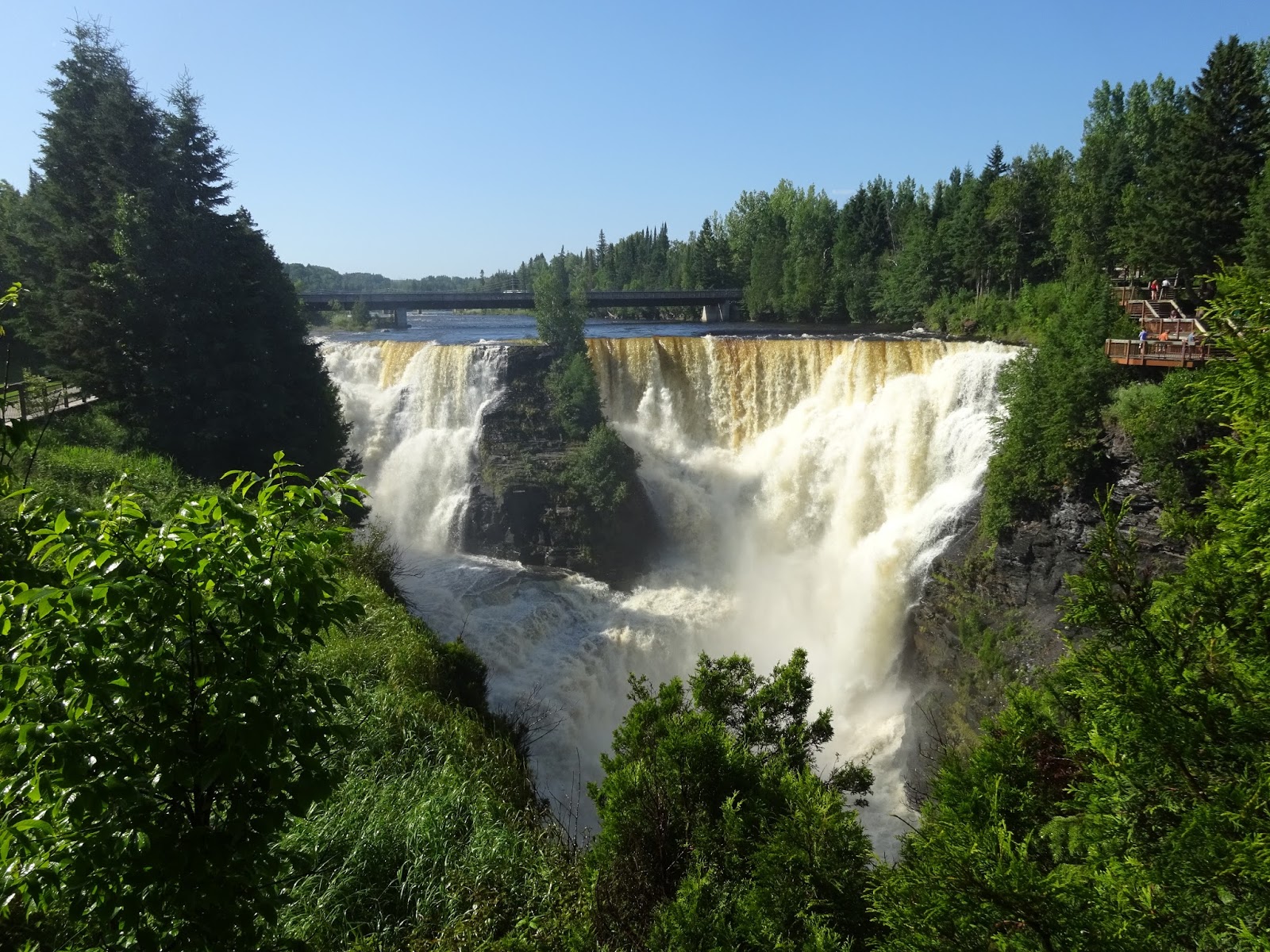
We got up at 4 a.m. on July 20 in order to catch our 8:30 flight from Newark NJ to Toronto. It was delayed an hour and our connecting flight to Thunder Bay was also delayed. Merle and Edith were there to pick us up when we arrived. Then we had a 4.5 hour drive to their home in Sioux Lookout. We stopped at two scenic points along the way. One was a mountain range known as The Sleeping Giant which has an Indian legend behind the name. The other was Kakabeka Falls.


It was difficult to get a full shot from top to bottom of this roaring falls.


We stopped for supper so it was time for bed when we got to the end of the day's journey. We thought we will be in the cool north but it was 91 that day. However, it had cooled off by the time we went to bed and a ceiling fan was sufficient. After that, it was cooler and usually in the low 80s. The residents thought it was hot but we were comfortable. During the week we got news from home that it was in the upper 90s to 100 so we escaped the worst heat wave of the summer.
The purpose of this trip was to visit my brother and his wife and help them with whatever they were doing. Leroy helped Merle with some work on his property. I helped Edith finish two small comforts, pick raspberries and currents in their garden and tried to make myself useful. 


Of course, no trip to northwestern Ontario would be complete without going fishing. I went along the first evening Leroy and Merle went fishing. We canoed all around the lake without catching anything. Then they fished from the bank under a bridge. We went home with the grand total of one Northern Pike (or jack) fish. It wasn't what Merle wanted but was enough for a meal.


The next time they went out they came back with absolutely nothing. Merle said this was the worst fishing he had in a long time. But on the third try they brought home a bass and three jacks.


And the last day they hit the jackpot. They caught about a dozen fish but threw most of them back because they were jacks and only kept their limit of walleyes. Then Merle was happy he had taken Leroy on a real fishing trip. 


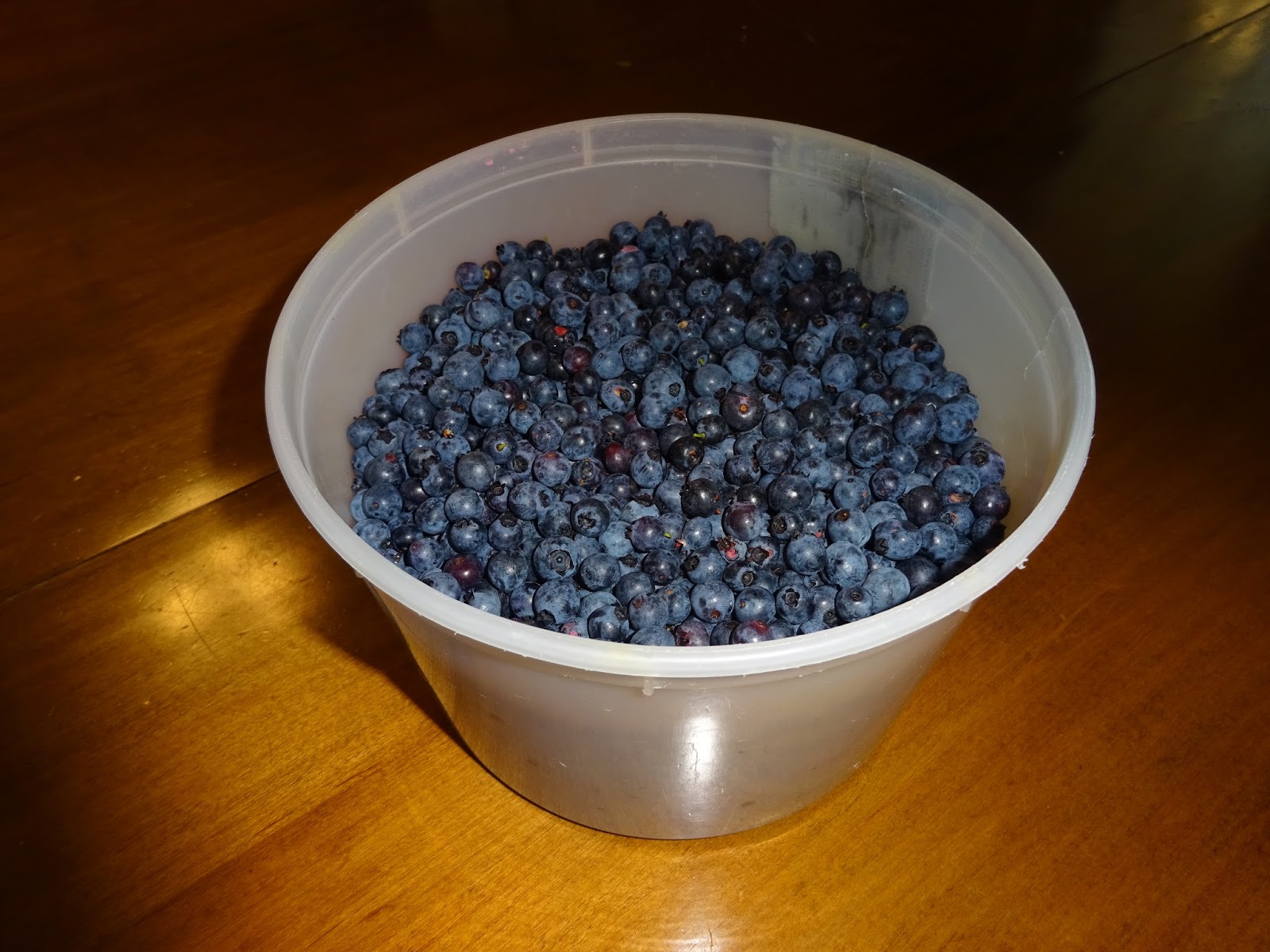
While the men were fishing, Edith and I went blueberry picking in the bush. Edith was on alert because this is the time of year bears are eating berries but I was blissfully ignorant of the danger. We picked for an hour and brought home a good two quarts of berries. That evening we feasted on fish and blueberries, like natives eating off the land.


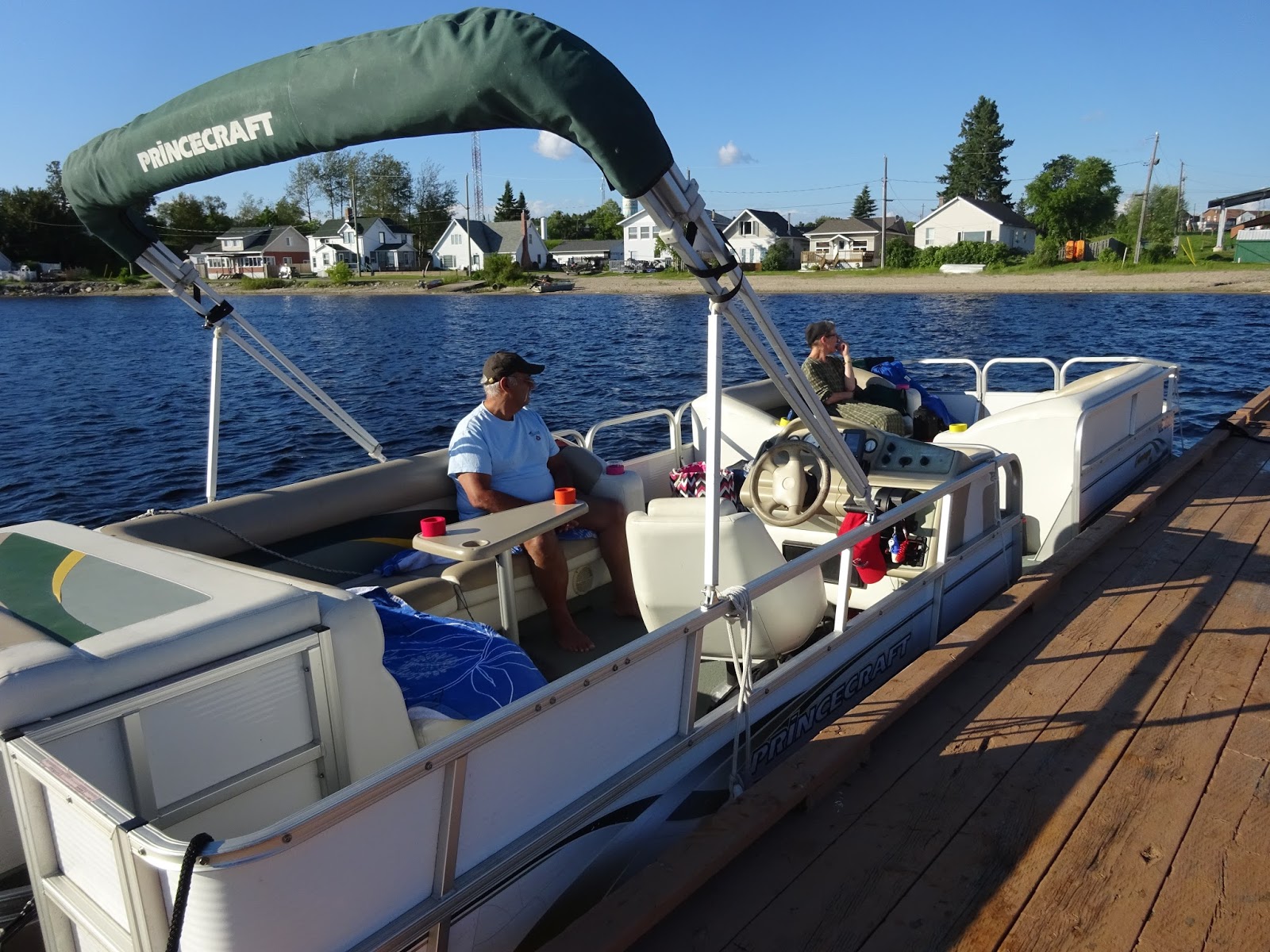
One evening two couples Merle and Edith know took us out on the lake on their pontoon boat. It was a beautiful evening. The highlight of that little excursion was seeing the eagles feasting on the scraps the fishing camp throws out on the edge of the lake every evening. The eagles know when and where the free food will be available and begin to congregate. It was hard to get an accurate count, but we estimated about twenty or thirty of the Bald Eagles made use of the fly-through lane of their favorite fast food restaurant. Some were young ones whose heads had not yet turned white but there were many mature birds in the flock.


On Sunday the church had their annual morning service in the park followed by a church picnic. It was a lovely day and the mosquitoes were not disturbing the peace. Some black flies came uninvited and bit our ankles but the mosquitoes must have been off in hiding somewhere. In case you wonder, I'm not complaining!
We helped Merle serve a soup and sandwich meal to the street people in the church basement from 4-6 pm. About twenty-five men and women came and went in two hours. Merle serves them every Sunday and knew most of them by name. The leftover hamburgers and sausages from the church picnic were sent with us and were a special treat for our guests. We first served a pot of chicken rice soup and when that was gone resorted to the standard mushroom soup. One man came in and asked what kind of soup we had. When Merle said it was mushroom he said he'll take some. He had been in earlier but knew if he waits a bit he might get his preference of mushroom soup. Leroy and I made sandwiches (quite a few "to go") and helped wash dishes. 

Sometimes "washing feet" is wiping dishes. 

Merle and Edith thought they would take us to see Fort William at Thunder Bay when we arrived, but our flight was delayed and then it was too late. Our flight home didn't leave Thunder Bay until 2pm so we decided to leave early enough to squeeze it in before we go to the airport. That meant getting up at 4am again. We left the house at 5 and got to Fort William at 10:30. The two hours we had to see the place was not enough time to see everything but we got a good overview of the fur trade during the end of the 1700s and early 1800s. 


Fort William was where east met west. There was some rivalry between the Hudson Bay Company in the east and Northwest Company in the west. Northwest harvested furs as far west as Alberta and brought them to Thunder Bay. Trade goods were brought in from the Hudson Bay Company and furs were shipped from Thunder Bay as far east as Montreal. 
Fort William was more than a trading post. It was actually a complete village with all the tradesmen needed to sustain life in the north at that time. Before we went in the gate two natives told us to remember it is 1816 and there is danger. One of the officials from the Hudson Bay Company was there and had been drinking too much. It was not good and there was likely to be a skirmish later in the day. We didn't stay long enough to witness that but all the native guides kept talking about the danger.

The mosquitoes were terrible at Fort William. Merle ran back to the car to get the insect repellent. While we waited, the natives who lived in this summer home showed us the pelts they were drying and told us a beaver pelt is worth one credit. Three beaver pelts would buy a blanket. They like the blankets and cloth they can buy with the furs. We kept swatting mosquitoes and told her we are waiting for Merle to bring the insect repellent. She said she never heard of that but we could rub bear grease on our skin to keep the mosquitoes away. We said we didn't have any and unfortunately, they had used all of theirs so we just had to wait for our spray bottle.


We went through several buildings where the fur business was conducted. This was the warehouse where furs were stored until shipment. We saw anything from grizzly bear to wolverine, mink, otter, white fox, raccoon, to you name it. If it lives in the North, it was there.


This is part of the trading post where furs could be exchanged for blankets and other goods. The guide asked if we have a contract with the Northwest Company. When we said we didn't, she apologized for not being allowed to let us buy anything. Only those who have contracts with the company can buy from their store. And then she let us in on a secret. The voyagers sign three-year contracts They can buy from the store without paying until the end of the contract. Then they are paid as much as is left after their store bill is deducted. What they don't know when they buy the supplies they need is that the company uses different money and the goods they buy from the store costs double what they would have to pay elsewhere. At the end of the contract when the accounts are settled, if they owe more to the store than they earned they can sign another three-year contract. It's a trick the company uses to keep the voyagers working for them.


Along the wall in this building are bales of furs ready to be shipped out and blankets and other goods which have been brought in. Imports and export records were kept to keep the business running.


A birch bark canoe was being constructed in the canoe shop. These canoes were made completely of natural products with bark for the shell supported by a framework of wooden ribs on the inside and sewed together with the roots of spruce saplings. It took about a week to make a canoe. Voyagers made their living paddling these canoes all the way from Thunder Bay at the top of Lake Superior to Montreal. I cannot imagine doing that!! When you consider how much a canoe could carry compared to an 18-wheeler, it was a lot of hard work for a small amount of goods. But that was the only way to do it in the eighteenth century.


Partners lived more elaborately than some of the others in the village. The most important people dined with fine china, glass, and silverware. This is the accounting office where the records were kept. Each box on this shelf is labeled with the name of the location to which it belongs and I suppose held the records and money that belonged to that account. A few of the names are Fort Dauphin, Lower Saskatchewan River, Upper English River, and New Caledonia.


We could have spent all day at Fort William but we had a flight to catch so we left at 12:30 and headed for the airport. Our final taste of Canada was at a Tim Horton's in the airport after we had checked in. Tim Horton's is THE fast food Canadian restaurant. The food was very good. 
Our flight from Thunder Bay to Toronto was about twenty minutes late and the one from Toronto to Newark, NJ was an hour late. We landed in Newark at 7:30. It took an hour to go through customs and get to our car and another two hours to drive home. It was a good trip and we enjoyed our Northwest vacation, but it's always good to be home again.