Comments are welcome but please have the courtesy to sign your name. Unsigned comments will be deleted.

Wednesday, July 27, 2016

Northwestern Ontario Vacation

My brother Merle has lived in northwestern Ontario for 38 years. We went up several times to see them but had not been there since they moved into the town of Sioux Lookout three years ago. We decided to go this summer and set the dates which fit both our schedules for July 20-26. It takes two long days of travel to drive there. We didn't feel up to that so we flew and made the trip in one long day instead of two. 
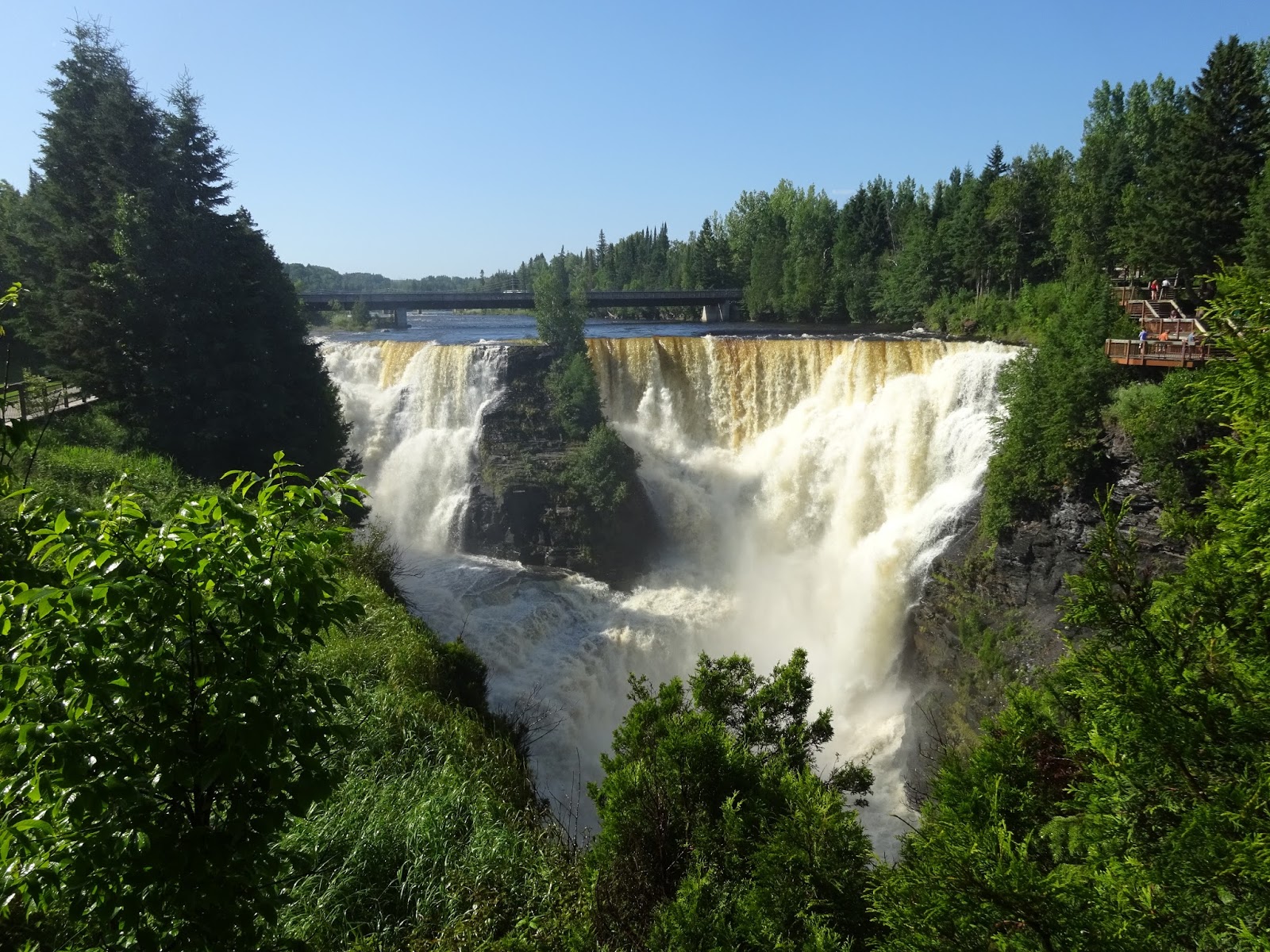
We got up at 4 a.m. on July 20 in order to catch our 8:30 flight from Newark NJ to Toronto. It was delayed an hour and our connecting flight to Thunder Bay was also delayed. Merle and Edith were there to pick us up when we arrived. Then we had a 4.5 hour drive to their home in Sioux Lookout. We stopped at two scenic points along the way. One was a mountain range known as The Sleeping Giant which has an Indian legend behind the name. The other was Kakabeka Falls.
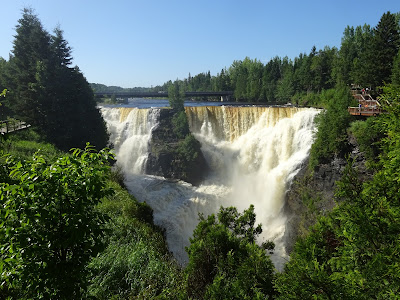


It was difficult to get a full shot from top to bottom of this roaring falls.

We stopped for supper so it was time for bed when we got to the end of the day's journey. We thought we will be in the cool north but it was 91 that day. However, it had cooled off by the time we went to bed and a ceiling fan was sufficient. After that, it was cooler and usually in the low 80s. The residents thought it was hot but we were comfortable. During the week we got news from home that it was in the upper 90s to 100 so we escaped the worst heat wave of the summer.
The purpose of this trip was to visit my brother and his wife and help them with whatever they were doing. Leroy helped Merle with some work on his property. I helped Edith finish two small comforts, pick raspberries and currents in their garden and tried to make myself useful. 


Of course, no trip to northwestern Ontario would be complete without going fishing. I went along the first evening Leroy and Merle went fishing. We canoed all around the lake without catching anything. Then they fished from the bank under a bridge. We went home with the grand total of one Northern Pike (or jack) fish. It wasn't what Merle wanted but was enough for a meal.


The next time they went out they came back with absolutely nothing. Merle said this was the worst fishing he had in a long time. But on the third try they brought home a bass and three jacks.


And the last day they hit the jackpot. They caught about a dozen fish but threw most of them back because they were jacks and only kept their limit of walleyes. Then Merle was happy he had taken Leroy on a real fishing trip. 


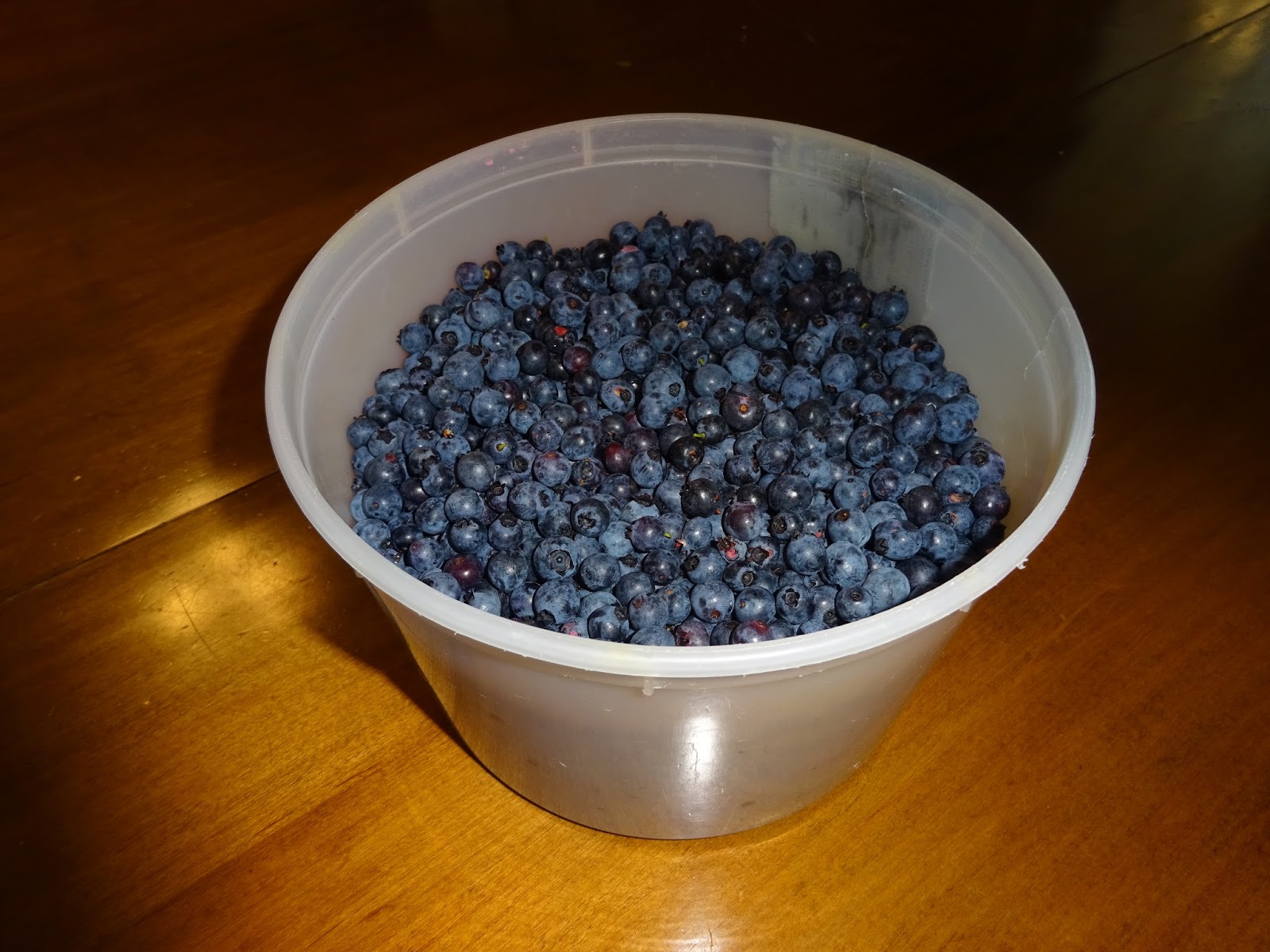
While the men were fishing, Edith and I went blueberry picking in the bush. Edith was on alert because this is the time of year bears are eating berries but I was blissfully ignorant of the danger. We picked for an hour and brought home a good two quarts of berries. That evening we feasted on fish and blueberries, like natives eating off the land.

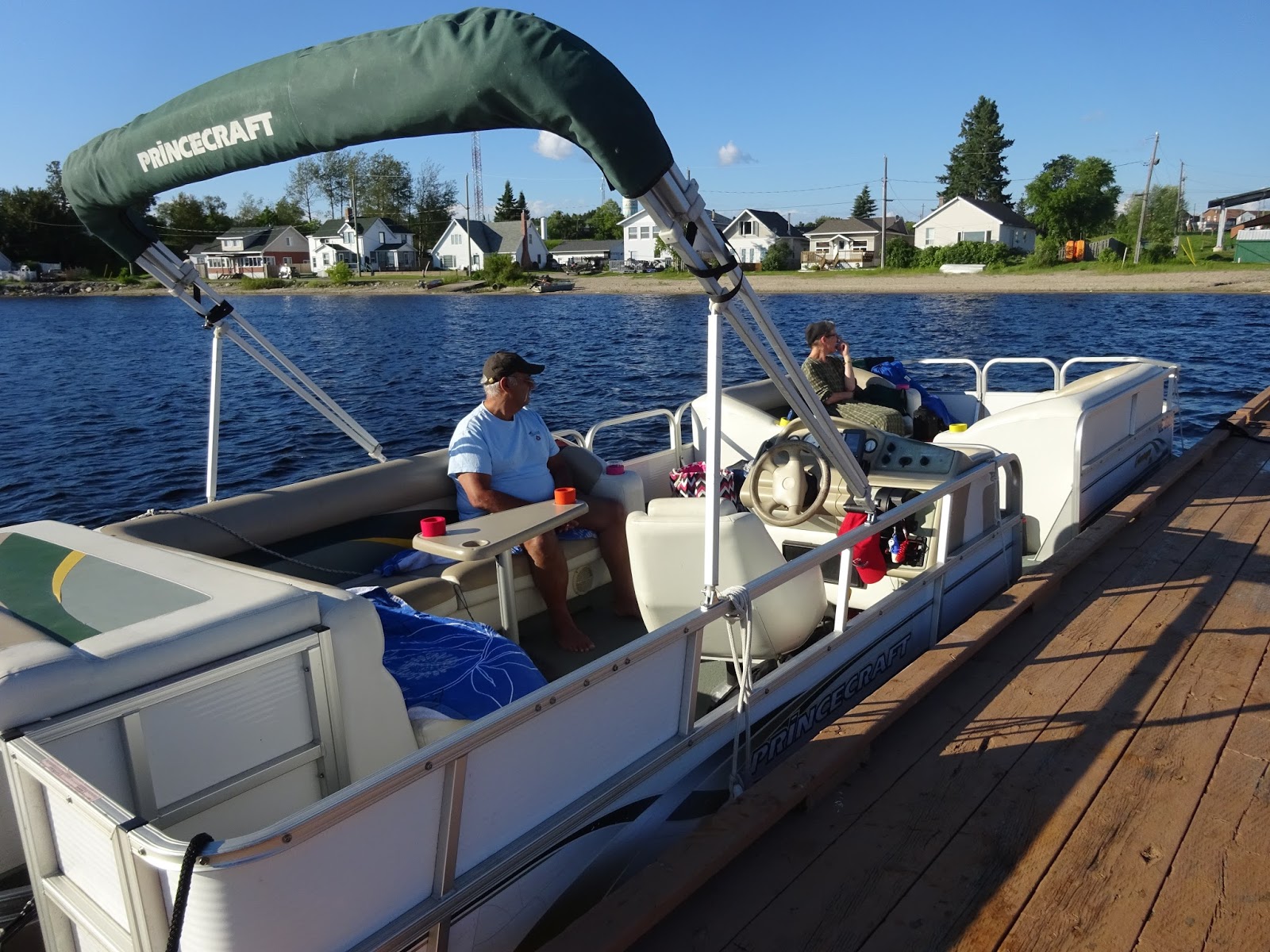
One evening two couples Merle and Edith know took us out on the lake on their pontoon boat. It was a beautiful evening. The highlight of that little excursion was seeing the eagles feasting on the scraps the fishing camp throws out on the edge of the lake every evening. The eagles know when and where the free food will be available and begin to congregate. It was hard to get an accurate count, but we estimated about twenty or thirty of the Bald Eagles made use of the fly-through lane of their favorite fast food restaurant. Some were young ones whose heads had not yet turned white but there were many mature birds in the flock.

On Sunday the church had their annual morning service in the park followed by a church picnic. It was a lovely day and the mosquitoes were not disturbing the peace. Some black flies came uninvited and bit our ankles but the mosquitoes must have been off in hiding somewhere. In case you wonder, I'm not complaining!
We helped Merle serve a soup and sandwich meal to the street people in the church basement from 4-6 pm. About twenty-five men and women came and went in two hours. Merle serves them every Sunday and knew most of them by name. The leftover hamburgers and sausages from the church picnic were sent with us and were a special treat for our guests. We first served a pot of chicken rice soup and when that was gone resorted to the standard mushroom soup. One man came in and asked what kind of soup we had. When Merle said it was mushroom he said he'll take some. He had been in earlier but knew if he waits a bit he might get his preference of mushroom soup. Leroy and I made sandwiches (quite a few "to go") and helped wash dishes. 

Sometimes "washing feet" is wiping dishes. 

Merle and Edith thought they would take us to see Fort William at Thunder Bay when we arrived, but our flight was delayed and then it was too late. Our flight home didn't leave Thunder Bay until 2pm so we decided to leave early enough to squeeze it in before we go to the airport. That meant getting up at 4am again. We left the house at 5 and got to Fort William at 10:30. The two hours we had to see the place was not enough time to see everything but we got a good overview of the fur trade during the end of the 1700s and early 1800s. 


Fort William was where east met west. There was some rivalry between the Hudson Bay Company in the east and Northwest Company in the west. Northwest harvested furs as far west as Alberta and brought them to Thunder Bay. Trade goods were brought in from the Hudson Bay Company and furs were shipped from Thunder Bay as far east as Montreal. 
Fort William was more than a trading post. It was actually a complete village with all the tradesmen needed to sustain life in the north at that time. Before we went in the gate two natives told us to remember it is 1816 and there is danger. One of the officials from the Hudson Bay Company was there and had been drinking too much. It was not good and there was likely to be a skirmish later in the day. We didn't stay long enough to witness that but all the native guides kept talking about the danger.

The mosquitoes were terrible at Fort William. Merle ran back to the car to get the insect repellent. While we waited, the natives who lived in this summer home showed us the pelts they were drying and told us a beaver pelt is worth one credit. Three beaver pelts would buy a blanket. They like the blankets and cloth they can buy with the furs. We kept swatting mosquitoes and told her we are waiting for Merle to bring the insect repellent. She said she never heard of that but we could rub bear grease on our skin to keep the mosquitoes away. We said we didn't have any and unfortunately, they had used all of theirs so we just had to wait for our spray bottle.


We went through several buildings where the fur business was conducted. This was the warehouse where furs were stored until shipment. We saw anything from grizzly bear to wolverine, mink, otter, white fox, raccoon, to you name it. If it lives in the North, it was there.


This is part of the trading post where furs could be exchanged for blankets and other goods. The guide asked if we have a contract with the Northwest Company. When we said we didn't, she apologized for not being allowed to let us buy anything. Only those who have contracts with the company can buy from their store. And then she let us in on a secret. The voyagers sign three-year contracts They can buy from the store without paying until the end of the contract. Then they are paid as much as is left after their store bill is deducted. What they don't know when they buy the supplies they need is that the company uses different money and the goods they buy from the store costs double what they would have to pay elsewhere. At the end of the contract when the accounts are settled, if they owe more to the store than they earned they can sign another three-year contract. It's a trick the company uses to keep the voyagers working for them.


Along the wall in this building are bales of furs ready to be shipped out and blankets and other goods which have been brought in. Imports and export records were kept to keep the business running.


A birch bark canoe was being constructed in the canoe shop. These canoes were made completely of natural products with bark for the shell supported by a framework of wooden ribs on the inside and sewed together with the roots of spruce saplings. It took about a week to make a canoe. Voyagers made their living paddling these canoes all the way from Thunder Bay at the top of Lake Superior to Montreal. I cannot imagine doing that!! When you consider how much a canoe could carry compared to an 18-wheeler, it was a lot of hard work for a small amount of goods. But that was the only way to do it in the eighteenth century.


Partners lived more elaborately than some of the others in the village. The most important people dined with fine china, glass, and silverware. This is the accounting office where the records were kept. Each box on this shelf is labeled with the name of the location to which it belongs and I suppose held the records and money that belonged to that account. A few of the names are Fort Dauphin, Lower Saskatchewan River, Upper English River, and New Caledonia.


We could have spent all day at Fort William but we had a flight to catch so we left at 12:30 and headed for the airport. Our final taste of Canada was at a Tim Horton's in the airport after we had checked in. Tim Horton's is THE fast food Canadian restaurant. The food was very good. 
Our flight from Thunder Bay to Toronto was about twenty minutes late and the one from Toronto to Newark, NJ was an hour late. We landed in Newark at 7:30. It took an hour to go through customs and get to our car and another two hours to drive home. It was a good trip and we enjoyed our Northwest vacation, but it's always good to be home again.

Monday, July 11, 2016

God Knows What He's About

Our Sunday school lesson yesterday was on the God of all comfort who comforts us in our suffering and how that can help us comfort others in their suffering with the ultimate purpose of glorifying God. I would like to share a couple stories of people whose suffering is glorifying God. 

On May 2, Lloyd Weiler fell two stories onto concrete at a construction site and landed on his head. He was rushed to a trauma center with severe brain injury and a lot of broken bones. His life hung in the balance for about a week. Then he began to improve but they were told he has a long hard road to recovery ahead of him. But then they decided his broken bones are mending fine without surgery and sooner than anyone expected he was moved to a Rehab center for therapy. They expected him to be there about six weeks but in two weeks he was allowed to go home. Two months after the fall, he has regained the use of all his limbs, memory, and speech. He is still regaining his strength but is able to walk with only a cane and is back to working in his business office a couple hours a day. That is an amazingly speedy recovery from the brink of death and only God could have made that happen. PTL!

On May 9 a couple from our church had their first child. Hans Risser, born at 24 weeks weighed 1 lb. 6 oz. He is still in the hospital but growing and developing with the help of modern medicine. He is now over three pounds and off the ventilator. If he had not been wanted, he could have been legally aborted. But he is a living testimony that a 24-week fetus is a person and not "just tissue" as some people claim. Yes, the medical profession has learned how to care for such tiny babies but it is God who gives them the wisdom and He who decreed this child should live. PTL!

On Saturday we visited with one of my husband's cousins. Their three-year-old granddaughter, Allison Wanner, was diagnosed with acute leukemia this spring. She was in the hospital for treatment for several weeks and then allowed to go home for one week before the next round of treatment began. This pattern will be repeated several more times. During the first week she was at home, a baby boy joined the family. The grandma said she thought this is just too much at once to have a very sick child and a new baby. But God knows what He is doing and His timing was perfect. The little girl will need a stem cell transplant so when the baby was born they saved the stem cells in the cord and they are a perfect match. If he had been born three months earlier they would not have known they would need that material in the cord. PTL!

These are just three examples of God at work in the lives of people we know. We don't always know why things happen the way they do but we can trust our God. He does not allow anything to happen to us that cannot be used for our good and His glory. 

God Knows What He’s About 

When God wants to drill a man, 
And thrill a man, and skill a man, 
When God wants to mold a man 
To play the noblest part; 
When He yearns with all His heart 
To create so great and bold a man 
That all the world might be amazed, 
Watch His methods; watch His ways. 
How He ruthlessly perfects 
Whom He royally elects! 
How He hammers him and hurts him 
And with mighty blows converts him 
Into trial shapes of clay 
That only God understands, 
While his tortured heart is crying, 
And he lifts beseeching hands! 
How He bends but never breaks 
When his good He undertakes. 
How He uses whom He chooses, 
And with every purpose fuses him; 
By every act induces him 
To try His splendor out— 
God knows what He's about! 
Author Unknown 

Thursday, July 7, 2016

Hershey Rose Gardens

We sisters got together again yesterday to celebrate the oldest sister's birthday. The birthday girl gets to choose the activity and she chose the Rose Garden at Hershey. I have not been there for many years and enjoyed seeing it again.
We started in the enclosed Butterfly Garden. It was full of unique butterflies I've never seen before. The bright blue one especially took my eye. When it sat down and folded its wings, it looked like this. 

The blue was only visible when it was flying or if you were quick enough to catch it when it landed.


The rose gardens were past the peak of their blooming season but still beautiful.

There were roses in every color of the rainbow but this one called Cherry Parfait was my pick of the crop.


In addition to the rose garden, there are other sections for perennials, grasses, trees, a Japanese garden, and other things. There's always something in bloom. This is a Japanese Maple. The leaves have the maple leaf shape but they are variegated light green and white and very small.


It was a hot day in the low 90s but we ignored that and enjoyed the beauty. I don't get an income from Hershey Chocolate to pay a gardener so my flower beds will never match these professionally landscaped gardens but I don't have to own them to enjoy them. 

Thursday, June 30, 2016

Ran Through The Briars

I chalked one more thing off my bucket list yesterday. I wanted to see three small family cemeteries scattered through the Bareville-Leacock-Leola area. For the best photography, I needed to go in the morning of a bright sunny day. The opportunity presented itself yesterday and was all I could have wished for. It was even more fun because my sister went with me.
We started at the Hershey-Groff cemetery behind the barn on an Amish farm. I had been there before but it was at the wrong time of day. This time the sun was in the east and I got better photos.
Next we went to the Landis-Grabill cemetery. I had been told this cemetery is in a fence row but we walked right by it without seeing it. I asked at the farm house and one of the girls went with us to show us where it is. No wonder we couldn't see it! About half a dozen grave stones are standing between the trees and fragments of about that many more are lying on the ground. As we crawled around in that fence row the words of a poem popped into my head: "They ran through the briars and they ran through the brambles, and they ran through the bushes where a rabbit wouldn't go." The things we don't put ourselves through to find a gravestone! But we found it.
This one for John Landis is the one I wanted to see.  I highly doubt this is his original stone. In 1727 they usually used field stones, not a sculptured or dressed stone like this one. Also, the lettering is not worn enough to be nearly 300 years old. Nevertheless, gravestones for a person who died in 1727 are few and far between.
 

Our last stop was at the Gerber cemetery at Leola. Last year a couple men spent a lot of time and money restoring a neglected family cemetery on an Amish farm. Old gravestones disappear or become illegible over time. By the time this cemetery was restored in 2015, only 22 stones were left to tell their stories. This photo was taken by Steven Garver in October 2015 when the restoration was completed.

This cemetery is on the land which one of my Swiss immigrant ancestors, Christian Gerber, settled in 1744. He died in 1751 and was probably buried in this cemetery along with his wife and some of his sons. Christian was Amish and it is an Amish farm today. After Christian's death, his sons, John and Peter, received the patent for this land on October 31, 1765. The patent describes Christian as "an alien born out of Allegience to His Brittanic Majesty." In other words, he had not been naturalized and therefore was unable to obtain the patent (first deed) from the Penns.


Christian Gerber is my only Amish ancestor. The next generations left the Amish and my line eventually circled back to become Mennonite. My Gerber ancestors are:
Christian Gerber, d. 1751, m. Barbara
Peter Gerber, d. 1792, m. Magdalena
Jacob Gerber, b. June 8, 1775
Barbara Gerber, Oct. 15, 1816-Apr. 20, 1888, bap. Lutheran; m. Josiah Powl
Emeline Powl, Sept. 7, 1849-May 29, 1938; m. Joseph Burkholder; bu. Groffdale (frame) Mennonite Cemetery

Friday, June 17, 2016

Fort Pomfret

I was asked to speak today to a group of ladies of the Daughters of Union Veterans in Snyder County. We took a short side trip to see Fort Pomfret which is one of the oldest historic sites in the county.
Pomfert Castle or Fort Pomfret was one of several forts that were planned during the winter of 1755-56 as part of the defensive plan west of the Susquehanna River.  It was ordered to be built along the Mahantango Creek and it is assumed that it was named in honor of Thomas Penn’s wife, Lady Juliana Penn, daughter of the Earl of Pomfret. Although it is not documented that this was the site of the fort, an archeological study in 1975 showed that the stone house was built on the foundation of an earlier building.
What can be proven is that Johannes Kroebil (John Graybill, 1735-1806) was the first settler in this valley. In 1774, he bought the land on which this old house stands. He was the first settler in this valley.  The house is approximately 20 x 28 feet and consists of two rooms on the first floor with a loft above and a basement that has a solid ceiling of 28-foot hand-hewn logs and an enclosed never-failing spring. 


There is no well on this farm as the spring provides all the water that is needed for the farm and family. It runs out from under the basement and flows away in a long stream.


The slits in the basement wall may simply have been for ventilation but are often supposed to have been for defense against Indians. John Graybill was a Mennonite and not likely to shoot at Indians. Building a house over a spring was certainly a common practice and a precaution for Indian attacks. The family did not have to leave the house for water if there was danger outside. The basement spring also provided refrigeration for perishable foods and helped cool the house in hot summers.


Amos Winey, who married John Graybill's granddaughter, Barbara, acquired the property in 1829. In 1851, he built the present farmhouse next to the small stone house. The homestead was in the Winey family about 170 years. In 1999, the Winey heirs sold the farm to an unrelated Burkholder family. John Graybill and his descendants had owned the property for more than two centuries, from 1774 to 1999.
The old stone house was falling apart when the Burkholders bought the farm. It needed to either be torn down or repaired. Fortunately, the Burkholders recognized the value of the old building and did not demolish it. The Juniata Mennonite Historical Center financed the restoration of the exterior of the building. The stones were repointed and windows repaired. The interior was not restored but with solid walls and a tight roof, it should stand a long time. 

Monday, June 13, 2016

Separated Unto God

Our Sunday school lessons this month are from the book of Exodus. The life of Moses and the deliverance of the Israelites from slavery in Egypt is a fascinating period of history. The Hand of God is clearly seen as events unfolded.
As I studied to teach yesterday's lesson, I thought about the fact that the Hebrew people lived in Egypt for 430 years. That's a long time! How did they manage to maintain their identity and not become mixed with the Egyptians or assimilated to their culture? They were separated from the Egyptians by their occupation (slavery), language (Hebrew), and faith in God. These three things made it possible for them to remain a separate people while living in Egypt for more than 400 years.
How long is 400 years? The first permanent English settlement in America was made at Jamestown, Virginia, in 1616. Jamestown celebrated its 400th anniversary in May 2016. We have another 30 years to go until Europeans have been in America as long as the Israelites were in Egypt. How has America changed since 1616? How has life changed?
After the founding of Jamestown, nearly another 100 years passed before the first European settlement was made in Lancaster County in 1710. These first settlers were Mennonites who bought land in the Pequea area. For the next 200 years, Mennonites (in general) maintained their identify as a separated people by their occupation (farming), language (German), and Anabaptist faith. They stuck to the twin doctrines of nonresistance and noncomformity through times of peace and war alike.
Around the turn of the twentieth century, things began to change. Mennonites began establishing colleges and adapting practices of Protestant groups such as Sunday school, revival meetings, etc.  As the Mennonite population increased, farm land became scarce. Families began to leave the farms and become involved in business which required the use of the English language. The switch to the English language was boosted by the hatred of the public for Germany during two World Wars.
When no longer separated from the world by occupation and language, only their Anabaptist faith was left as a mark of separation.  As Mennonites (in general) became more and more assimilated to the culture, the first of the twin doctrines to fall was noncomformity. Mennonites could no longer be identified by their simple dress, homes, and churches. Sadly, today Mennonites are fast losing the doctrine of nonresistance which is the one remaining difference between Anabaptists and Protestants. 
But all is not lost. There is a large number of conservative Mennonites who are maintaining the historic Anabaptist doctrines of nonresistance and nonconformity. There is also a large number of Old Order Mennonites and Amish who are maintaining the German language. Many have moved to other areas where they established new settlements in order to maintain their occupation of farming. The conservative and Old Order groups which are maintaining their identity are growing more rapidly than those who have become assimilated to the culture.
On April 5, 2014, Ervin Stutzman, executive director of the Mennonite Church USA, gave an address titled "Can the Quiet in the Land Keep Their Peace" at the Annual Banquet of the Lancaster Mennonite Historical Society. He said:
 
"Until a century ago, the two words "nonconformity" and "nonresistance" expressed the Amish and Mennonite church’s stance vis-à-vis the outside world and its approach to war. These two concepts were so closely joined that some referred to them as Siamese twins. Conservatives warned that if the church lost its nonconformity in matters such as the practice of distinctive dress, they would also eventually lose nonresistance in both principle and practice. This may well be true since willingness to dress distinctively is a strong indication of group conformity as a sect and unwillingness to assimilate into a culture. The more that a church group assimilates into the surrounding culture, the more difficult it will be to maintain a stance of nonparticipation in the nation’s wars.
In light of the changes that have taken place over the past several generations, can the quiet in the land keep their peace?
Yes, I believe the Amish and the other Anabaptist groups who insist on visible practices of nonconformity can likely keep a focus on nonresistance, at least on not going to war. For them, nonresistance and nonconformity can remain as "Siamese twins." To the extent that they remain as sects apart from society, they’ll at least have a reason for not participating in the nation’s wars."
(Pennsylvania Mennonite Heritage, July 2014)
 
I'm not saying we all need to be German-speaking farmers or that Sunday school and revival meetings are not good. But we do well to examine our lives and evaluate the direction we are moving. Have I relaxed my standards and begun allowing things in my life that I would not have done ten years ago? Am I moving closer to the Lord or the world? If we become assimilated to the culture and accept the world's practices and values, we will get the world's problems. The only way to maintain separation from the world is to be separated unto God.


Monday, June 6, 2016

Changing Times

Last spring my siblings and I sold the cabin our father built in 1984. He only lived two more years and then we took it over. We made many memories there but as the years rolled along our families got larger instead of smaller as in-laws and grandchildren were added. I held out as long as I could but about five or six years ago was forced to admit our clan had totally outgrown that cabin. We found another place to go which would accommodate our growing tribe and continued our family weekend in June.
We sisters had gone up to the cabin together every spring to clean it for the new summer season. We would go up Friday night and spend all day Saturday cleaning and maintaining the place. Eventually I faced the fact that we are making a lot of unnecessary work and expense for ourselves in keeping a cabin we no longer used. We consulted our brother (in Canada who didn't use it either) and agreed to sell it. We went up for the sale on May 23 and stayed for the weekend one last time.
 
 
After so many years of going to the cabin every spring, we decided we still want to have a sisters cabin weekend in the spring. We checked into several possibilities and eventually decided to try one that is in the same general area. We could still go to the same church we always went to when we were at the cabin. We might try a few more and see which one we like best but I certainly had no complaints about this one. It had more luxuries than we have at home, including central air and a dishwasher. It has a woodsy look but (in my opinion) is more of a house than a cabin.


The best part of this cabin is that we go and pay our rent but don't have to do any cleaning or maintenance work. We had all weekend to catch up on our loafing. We mostly read and napped but after supper we stirred ourselves a little and went to see what the new owner had done to our cabin. He hasn't done any major remodeling but did change the furnishings. It wouldn't be the same anymore and I have no desire to go back there. After we got back we played corn hole until dark.
 

It rained on Sunday but that was no problem. We were in church all morning and left about 3pm because we were going to a birthday party in the evening for our (borrowed) twin grandsons.
It's hard to believe that Dylan (left) and Durrell have reached the magical age of 16 already. I never forget how old they are because they were born July 4, 2000, and their age is always the same as the year. The party was held a month early and they were totally surprised. Got 'em good! Just hang on one more month guys, and you'll be in the driver's seat.